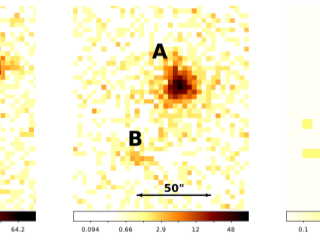
Hot Jupiters and Their Effects on Host Stars
Hot Jupiters offer an interesting mechanism for affecting the rotation and magnetic activity levels of their host stars.

Hot Jupiters offer an interesting mechanism for affecting the rotation and magnetic activity levels of their host stars.
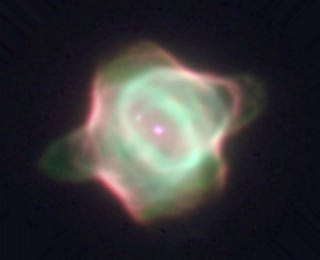
How can a star heat up by 40,000 K in just 30 years? Reindl et al. explore the star at the heart of the Stingray Nebula to find out.
Supermassive black holes are everywhere in our Universe, but we don’t know where they came from. Supermassive stars could have given birth to these massive objects. However, that is not all these fifty to one hundred solar mass stars could be responsible for…
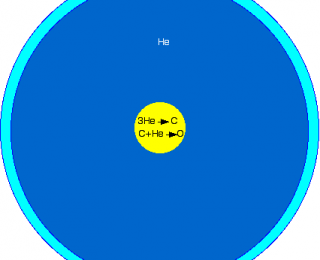
Enter the observed oddball: a subdwarf B (sdB) star. These unexpected stars are fusing helium into carbon and oxygen in their core and only have a thin hydrogen envelope. So, where did the hydrogen go?
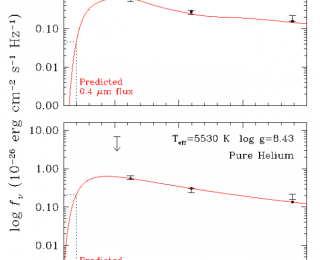
Most binary stars probably formed at the same time, meaning all stars in the same system should have the same age. The authors of this paper analyze a stellar binary system where one star appears to be lying about its age, as one star appears 3 billion years older than its companion.
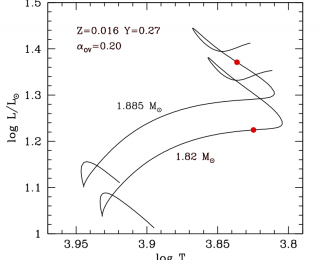
Kepler finds a new binary system with a Delta Scuti pulsator.