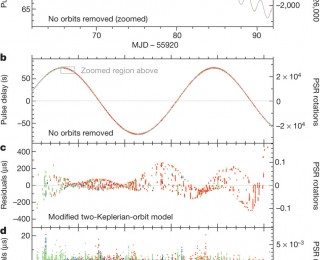
by Meredith Rawls | Jan 14, 2014 | Daily Paper Summaries
One of nature’s best clocks is a millisecond pulsar. These exotic stellar corpses are neutron stars: incredibly dense, rotating hundreds of times per second, and emitting powerful jets or beams of light. This creates a “pulsing” effect, much like a lighthouse.
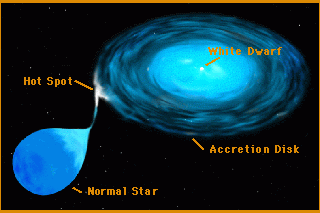
by Korey Haynes | Nov 26, 2013 | Daily Paper Summaries
Cataclysmic variables are binary star systems where one of the stars—a white dwarf—devours its main sequence partner over time. Kepler proves yet again that it can find a lot more than just exoplanets by identifying a cataclysmic variable with a period of less than an hour.
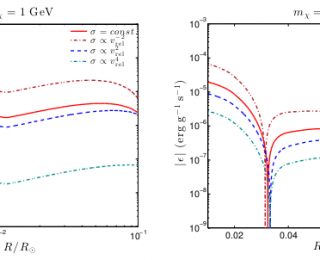
by Anson Lam | Nov 25, 2013 | Daily Paper Summaries
Depending on how they scatter with nuclei, dark matter particles might affect the structure and evolution of our Sun.
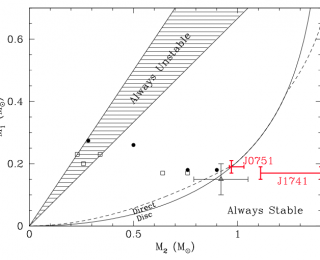
by Josh Fuchs | Oct 31, 2013 | Daily Paper Summaries
The progenitors of a special type of cataclysmic variable, AM CVn, and possibly supernovae have been found.
by Maria Drout | Oct 21, 2013 | Daily Paper Summaries
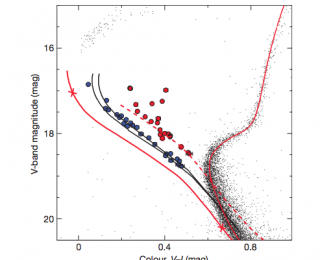
The authors identify two distinct sequences of blue straggler stars in the globular cluster NGC 392. They hypothesize that one branch is formed via stellar mergers and the other is binary stars undergoing mass transfer. This is the second globular cluster found to possess this double sequence.
by Ben Montet | Sep 20, 2013 | Daily Paper Summaries
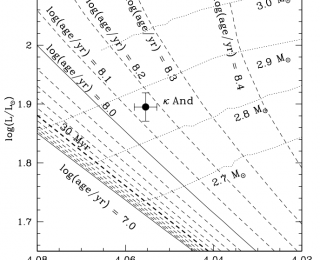
A “Super-Jupiter” recently discovered by direct imaging techniques may not be as it initially seemed. Hinkley et al. find the system to be older than expected and the Super-Jupiter to really be a brown dwarf.
