by Elisabeth Newton | Sep 26, 2012 | Daily Paper Summaries
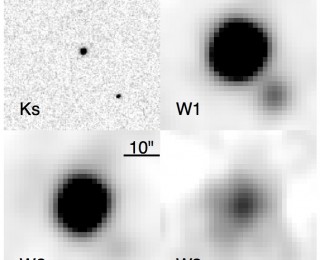
Astronomers like to find cool things. The first Earth-sized planet. The most distant galaxy yet. Two stars that merged while we watched. The coolness factor is certainly one reason why we keep at it – who wouldn’t want to be the first to find an Earth-sized planet, or the first human to see light from a galaxy that’s existed for billions of years? But there’s also a compelling scientific reason to search for these oddballs. This paper reports on the likely discovery of dust around a pair of binary stars.

by Anna Rosen | Aug 15, 2012 | Daily Paper Summaries
What happens to a low-mass companion when a star evolves off the main sequence to become a white dwarf?
by Elisabeth Newton | Aug 1, 2012 | Daily Paper Summaries
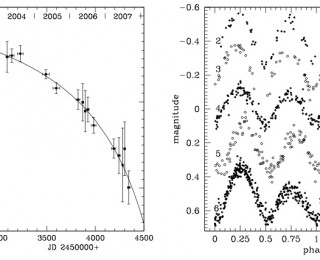
V1309 Sco first caught astronomers attention in 2008, when it displayed an outburst, suddenly getting a hundred times brighter. Due its location near the Galactic center, V1309 Sco has been monitored by the OGLE, which is looking for microlensing events, since 2001. The authors of this paper were able to look back into this archive of data and see what V1309 Sco was doing before it erupted.
by Nathan Goldbaum | Jun 16, 2012 | Daily Paper Summaries
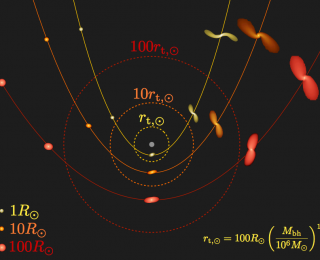
One possible way to directly infer black hole properties is by observing the sort of event discussed in today’s paper: the tidal disruption of an individual star after a close approach to a supermassive black hole.
by Elisabeth Newton | Apr 26, 2012 | Daily Paper Summaries
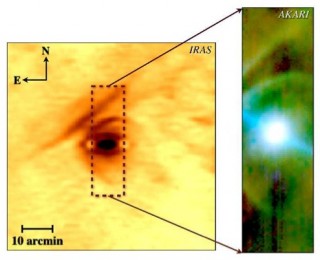
Sometimes we see strange shapes when we look through our fancy telescopes and we’re left wondering how they formed. How did the rings and “pearls” of SN1987A form? Or the hexagonal cloud pattern on Saturn? The star Betelgeuse – famous for being Orion’s left shoulder – presents another unusual geometric appearance.
by Ian Czekala | Apr 15, 2012 | Daily Paper Summaries
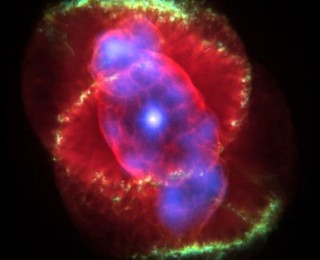
It’s a fact of the universe that most stars are members of a binary system. However, our knowledge of stellar evolution has most thoroughly treated the case of a single, isolated star evolving according to its own schedule, dictated by the well-understood equations of stellar structure. What happens when the binary stars have tight enough orbits to influence each other?
