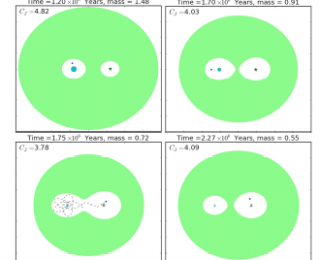
Star Hoppers: Planets in Evolving Binary Star Systems
What happens to planets in binary star systems when the primary star evolves off the main sequence? Can the planet survive?

What happens to planets in binary star systems when the primary star evolves off the main sequence? Can the planet survive?
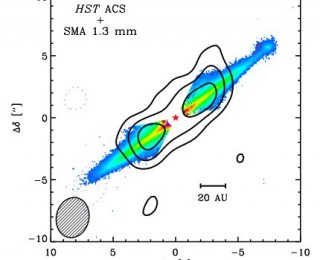
AU Mic is a low mass star that undergoes unpredictable brightening events, called flares. It’s located just 10pc and has a circumstellar disk. In this paper, Wilner et al. report on observations of the disk at millimeter wavelengths and find evidence for a planetesimal ring.
The basis for something called the “G dwarf problem” is the comparison between observations and a simple model for chemical evolution in a galaxy. To cut to the chase, there are fewer very metal poor G dwarfs than are predicted by this basic understanding. This discrepancy has been shown to hold for the Milky Way as well as for other galaxies. It also holds for K dwarfs in the Milky Way – and now for M dwarfs as well.
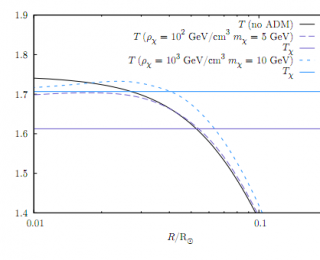
What happens to the structure and properties of a star in a the presence of dark matter?
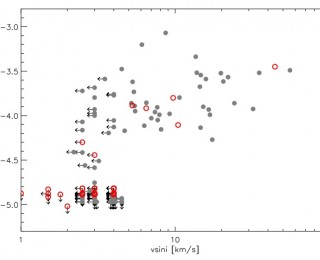
This paper delves into some of the physical properties of early M dwarfs (M0-M4.5), focusing on chromospheric/magnetic activity and rotation. The authors present a catalog of activity and rotation for 334 early M dwarfs.

Young massive stars have a variety of different rotation rates, but what sets these initial speeds? In this paper, the authors investigate whether magnetic fields could be the answer.