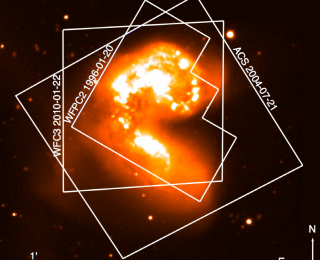
Gone Without a Bang
Failed supernovae result in massive stars disappearing into the night sky without a trace. Although many stars may meet this fat, we’re just beginning to look for them!

Failed supernovae result in massive stars disappearing into the night sky without a trace. Although many stars may meet this fat, we’re just beginning to look for them!
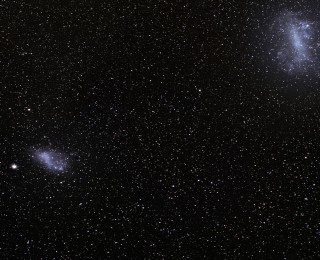
There is quite a lot left to learn about the smallest galaxies in our Universe, dwarf galaxies. Since they are small compared to galaxies like the Milky Way, they are challenging to observe directly, either because they are too dim or because they are too small to be resolved. The authors suggest a new detection method for these faint galaxies that takes advantage of ongoing and upcoming large surveys looking for, among other things, novae and supernovae.
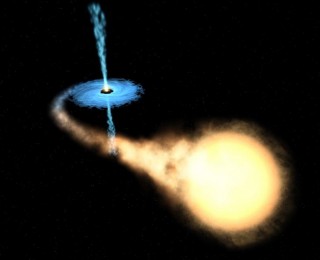
Reproducing the observed star formation history of galaxies in simulations is a fantastic test of our understanding of galaxy evolution. This is regulated strongly by “feedback”, for example, from supernova. Today’s astrobite discusses feedback from high mass X-ray binaries.
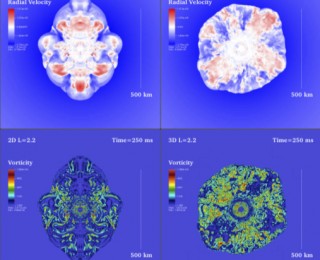
The neutrino reheating mechanism works out in theory to trigger core-collapse supernovae, but we’ve had a lot of trouble getting it to work in 3-dimensional simulations. Because of the prohibitive computational expense, really accurate neutrino physics have thus far only been implemented in 2D. This paper seeks to investigate whether there are systematic differences in fluid behavior between 2D and 3D models in order to figure out whether a 2D model can really stand in for a 3D one.
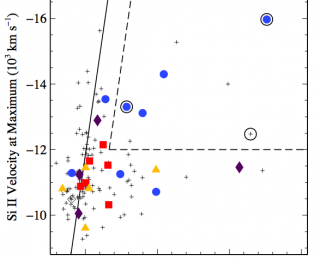
What if type Ia supernova are not all made the same way? For the first time, a study links type Ia supernova explosions to their parent systems, uncovering evidence for two different ways to produce these purportedly “standard” explosions.
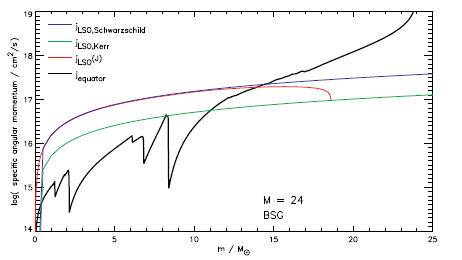
The collapsar model of gamma ray burst production posits that a black hole forms at the center of the star and sucks in the rest of the star’s mass, but that the inner regions have sufficient angular momentum to form an accretion disk which then radiates some fraction of its power in the form of a relativistic jet of matter beaming out of the star. But what if it were the outer, not the inner, layers of the star that had most of the angular momentum? The answer is a very different sort of gamma-ray transient.