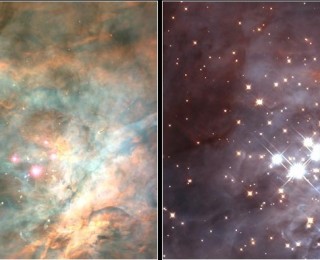
A Brand New Way to Determine Hubble’s Constant
This paper demonstrates a brand new method of calculating Hubble’s Constant using the luminosity of HII galaxies.

This paper demonstrates a brand new method of calculating Hubble’s Constant using the luminosity of HII galaxies.
Yesterday, after rumors surfaced on the Science Insider blog that OPERA’s startling superluminal result had been traced to a faulty cable, the collaboration sent out a press release stating that they had uncovered two previously unaccounted-for errors. Astronomers in particular have been skeptical of OPERA’s results based on an event that, coincidentally, occurred exactly 25 years ago today: the arrival of the neutrino pulse from Supernova 1987A. SN1987A is the closest supernova ever observed in modern times and still the only one for which we have detected the associated neutrino pulse, and it bloomed this night 25 years ago in the Large Magellanic Cloud.
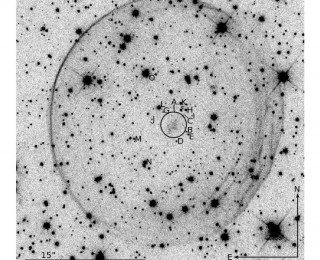
Schaefer & Pagnotta search supernova remnant 0509-67.5 for signs of an ex-companion to the white dwarf which exploded as a type Ia supernovae.
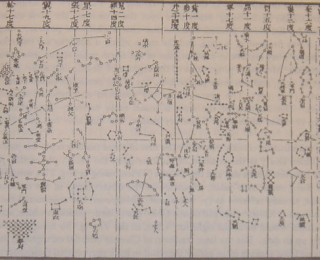
Astronomers combine ancient Chinese and Roman records with a modern understanding of astronomical events.
Last year on Christmas day, scientists observed a unique gamma-ray burst, GRB 101225A. Two interesting and very different models have developed for the ‘Christmas burst:’ a tidal disruption of a comet by a neutron star somewhere in our Galaxy, or a neutron star consuming its companion star over 5 billion light years away.
An overview of how astronomers identify and interpret light echoes.