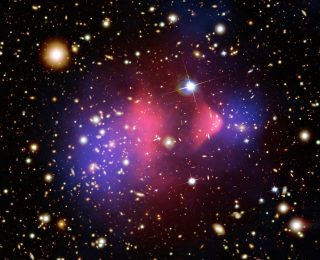
A Sonic Boom (Half) as Old as Time Itself
That’s quite a sonic boom, particularly given that the speed of sound in the hot plasma is around 2 million miles per hour!

That’s quite a sonic boom, particularly given that the speed of sound in the hot plasma is around 2 million miles per hour!
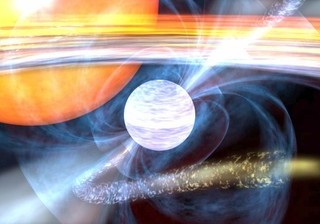
Pulsars, or rapidly-spinning neutron stars, have been observed to suddenly change in spin. Typically, the pulsars we’ve seen do this are isolated—what happens if they have a stellar companion?
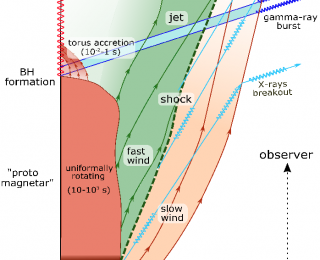
In today’s paper, Rezzolla and Kumar present a solution to the x-ray afterglow problem for the short gamma ray burst model. They show that x-rays can glow steadily for hours after the initial gamma ray emission due to the interactions of a slow and a fast wind.
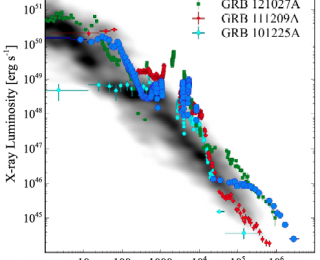
The longest-lasting, most energetic explosions in the universe might occur in rare stars very similar to the very first stars to form in the universe.
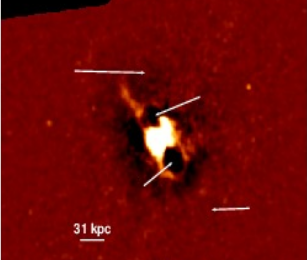
Gas in clusters is predicted to cool quickly, but observations suggest otherwise. What prevents the gas from cooling? The authors explore the incidence and impact of heating by active galactic nuclei.
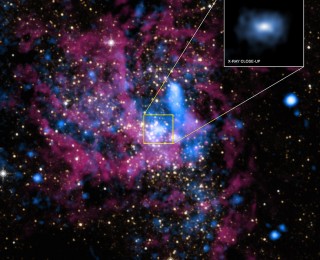
Sgr A* – the supermassive black hole sitting in the center of the Milky Way – is often referred to as a ‘starved’ black hole, meaning that it swallows very little of the nearby cosmic gas and dust. The authors of this paper observed Sgr A* with the Chandra X-ray telescope for 3 mega seconds, throughout which only 1% of the gas available to Sgr A* actually accreted onto the black hole. It swallows cold gas, while rejecting hot gas – ejecting the matter back into space.