
Title: Can premature collapse form black holes in the upper and lower mass gaps?
Authors: Thomas W. Baumgarte and Stuart L. Shapiro
First Author’s Institution: Department of Physics and Astronomy, Bowdoin College, Brunswick, Maine, USA
Status: Published in Physical Review Letters [closed access]
When a star dies, it usually leaves behind a compact remnant. Stars less than about 8 solar masses form white dwarfs, stars between about 8 and 20 solar masses form neutron stars, and stars greater than about 20 solar masses form black holes. But the distribution of remnant masses isn’t uniform. Instead, our current theories of stellar evolution predict two “mass gaps,” where no stellar remnants should exist.
The upper mass gap corresponds to stars with core masses between about 60 and 130 M⊙. These stars are thought to end their lives in pair-instability supernovae, a special type of explosion that destroys the star completely without leaving any remnant behind. Separately, the lower mass gap corresponds to the range between the largest possible neutron star (~3 M⊙) and the smallest possible black hole (~5 M⊙) that can be formed in supernova explosions. Though the exact limits of both mass gaps are subject to uncertainties, their existence is generally supported* by theoretical models.
Despite this, observations of gravitational waves have revealed the existence of black holes in both mass gaps (Figure 1). The recently-announced LIGO event GW231123 came from a merger between a 137 M⊙ black hole and a 103 M⊙ black hole, both of which land squarely in the upper mass gap. And the event GW230529 involved a black hole with a mass of 3.6 M⊙, which falls in the lower mass gap. The existence of these “impossible” objects implies that a mechanism other than supernova explosions must be producing the black holes we observe. But what could that mechanism be?
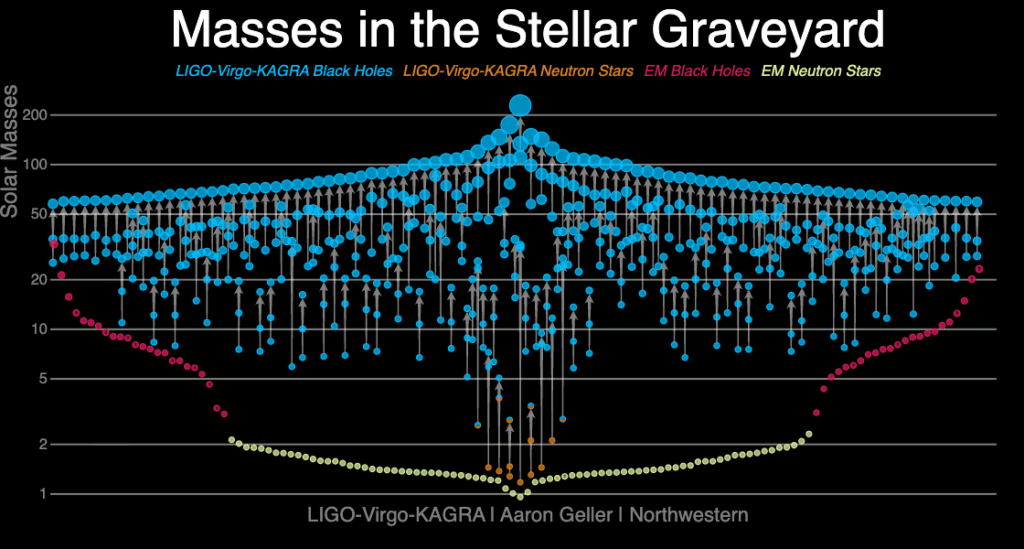
Though astronomers have proposed several ideas, reproducing the masses and spins of the observed black holes remains challenging. Today’s paper continues this effort by exploring a novel mechanism: “premature collapse” of stars in either mass gap, leading to remnants with unusual properties.
*The upper mass gap is especially well-established, while the lower mass gap is more debated; see e.g. reference 18 in today’s paper to learn more!
When stars bite off more than they can chew
Stars usually collapse when they’ve exhausted their fuel for nuclear fusion. Depending on the mass of the star, this process can take anywhere from millions to billions of years. Since stars spend most of their lives in stable equilibrium, a “premature” collapse requires an external trigger – like swallowing a tiny black hole.
Typically, an encounter between a star and a black hole will tear the star apart. But today’s authors suggest that if the black hole is significantly less massive (MBH << M∗), the star can gravitationally capture the black hole without being disrupted. The black hole will pass through the stellar envelope, spiraling inward until it reaches the star’s center. Once inside, it will accrete the star on a relatively short timescale, eventually triggering a premature collapse.
Black holes produced by this process should be spinning rapidly, a phenomenon we observe (e.g. in GW231123) but have struggled to explain with standard black hole formation mechanisms. Stars are usually born as fast rotators, but they also “spin down” with age, so the black holes produced in supernovae don’t inherit much angular momentum. In contrast, black holes produced by collapse early in a star’s life would inherit a more rapid spin, which could potentially explain the objects we observe.
Who’s stocking the cosmic snack aisle?
In order to be captured at all, the black hole has to lose enough energy on its first passage through the star to become trapped by the star’s gravity. The kinetic energy of the incoming black hole depends on its mass and velocity, while the drag force it encounters as it travels through the star depends on both its mass and the star’s structure. In general, denser stars have an easier time capturing black holes, since they have a stronger gravitational pull. However, the black hole must also be above a certain mass threshold in order to experience enough drag force to prevent its escape from the star. The authors calculate this minimum mass as a function of stellar radius and the velocity of the black hole:

The radii of main sequence stars range from 0.1 – 10 R⊙, while velocities in the disk of the Milky Way are typically 10 – 30 km/s. Plugging these values into Equation 1 yields minimum black hole masses ranging from 8.7e-7 M⊙ to 7.8e-4 M⊙, far below the lower mass limit for black holes produced by stellar evolution (~5 M⊙). However, a successful capture also requires MBH << M∗, which stellar-mass black holes can only satisfy for the most massive stars. In order for premature collapse to be plausible, a population of sub-solar-mass black holes is needed.
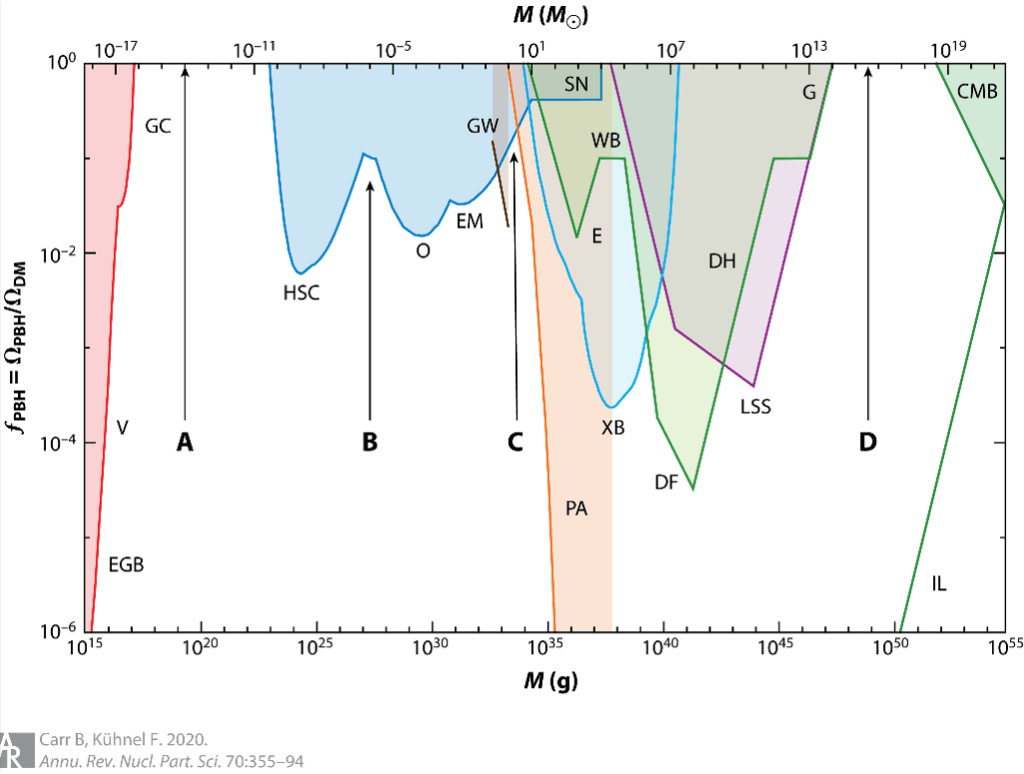
The most promising candidates are primordial black holes (PBHs), which are thought to have formed from density fluctuations in the early universe. Unlike black holes formed through stellar evolution, PBHs could theoretically span a wide range of masses, from smaller than planets to hundreds of solar masses. Dark matter searches have placed several constraints on PBH masses, ruling out most objects outside of the 1e-16 to 1e-10 M⊙ range (Figure 2). However, these black holes would be too small to be effectively captured by main sequence stars, as shown in Equation 1. Instead, the authors consider PBHs around 1e-6 and 1 M⊙, which could account for up to 10% of the dark matter in the universe.
A statistical look at stellar snacking habits
Assuming a PBH fraction of 10% and a local dark matter density of 1e-24 g/cm^3 (which is typical for the solar neighborhood), the authors calculate the expected number of stellar-PBH collisions as:

Here, Ntot depends primarily on the likelihood of capturing a PBH and number of PBHs available for capture. By combining Equation 2 with the Salpeter IMF, which describes the occurrence rate of stars as a function of mass, the authors estimate the total number of black holes expected in each mass gap from the premature collapse mechanism. They find that NBH for the upper mass gap is about 1e-3, while NBH for the lower mass gap is about 1e5.
As a point of comparison, the expected number of 10 – 60 M⊙ black holes in the Milky Way is 1e8. The vast contrast between this value and NBH,upper suggests that PBH-induced premature collapse is highly unlikely to form black holes in the upper mass gap. However, a significant fraction of black holes in the lower mass gap could be produced by this novel mechanism. In fact, premature collapse could even produce black holes below the lower mass gap by disrupting stars in the range of 1-2 M⊙.
The authors stress that their calculations depend on many assumptions, including the ability of a star to capture a black hole without being disrupted, the properties of dark matter and PBHs in the local Universe, and the galactic environment the collisions are taking place in. Even so, their work shows that premature collapse is a promising formation channel for low-mass black holes. As we continue to expand our capabilities to detect and interpret gravitational waves, we’ll be able to place stronger constraints on the existence and limits of both mass gaps. Whether stars snacking on tiny black holes turns out to be impossible, rare, or surprisingly common, we’ll be one step closer to explaining the “impossible” objects that our detectors continue to reveal.
Astrobite edited by Erica Sawczynec.
Featured image credit: NASA, ESA, and A. Feild and F. Summers (STScI), drawings added by A. Masegian.
