
Title: Volatile-rich evolution of molten super-Earth L 98-59 d
Authors: Harrison Nicholls, Tim Lichtenberg, Richard D. Chatterjee, Claire Marie Guimond, Emma Postolec, Raymond T. Pierrehumbert
First Author’s Institution: Department of Physics, University of Oxford, Oxford, UK
Status: Published in Nature Astronomy [open access]
We do not have time machines… but we have exoplanets
If you could rewind time, what would you fix? A failed cake, a questionable haircut, or that bold decision to start studying the night before the exam? Unfortunately, we don’t have time machines, but astronomers come surprisingly close. By observing distant exoplanets and building models of their evolution, astronomers attempt to reconstruct billions of years of exoplanetary history from the limited clues we can detect today.
Today’s paper focuses on L 98-59 d, a super-Earth orbiting an M-type star. With radius and mass about 1.6 times that of the Earth, it has a weirdly low density for a planet of this size, and is closer to something like compressed foam or volcanic pumice than the dense rock you might expect for a super-Earth. If a typical rocky exoplanet is a solid brick, then L 98-59 d is… suspiciously sponge-like.
Moreover, L 98-59 d’s relatively small size places it in the so-called “radius valley“. The radius valley is a dip in the observed distribution of small exoplanets, a kind of cosmic no-man’s-land. For unknown reasons, exoplanets do not like to stay there: they either cluster into gaseous worlds (e.g. sub-Neptunes) or rocky ones (e.g. super-Earths). This feature is important because it suggests that planets in this size range are not stable as an intermediate population, but instead tend to evolve toward either rocky or gaseous configurations. In turn, L 98-59 d’s position in this boundary region means that its origin is not straightforward to determine, so multiple formation histories remain possible.
One such scenario is that planets like this start out with thick hydrogen-rich atmospheres and then slowly lose them over time, eventually splitting into rocky and gaseous worlds. Another possibility is that some planets already form with different amounts of water depending on where they form in the protoplanetary disk, with respect to the ice line, leading to different bulk compositions from the beginning.
Given that L 98-59 d sits in the transition region between rocky and gaseous planets, it becomes an ideal test case for probing competing ideas about how small exoplanets form and evolve, since even subtle differences in its evolutionary history could determine which side of the “valley” it ultimately belongs to. In this sense, it would be incredibly useful if we could rewind time and trace back which of these evolutionary pathways L 98-59 d actually followed.
Rewinding L 98-59 d’s history without a time machine
But how do we actually “rewind” the history of L 98-59 d? Working backwards from its present-day properties to reconstruct its evolutionary path, the authors combine one-dimensional models of its atmosphere and interior in a coupled evolutionary framework, allowing both to evolve together over time.
In practice, they run hundreds of “what if this planet were born like this?” scenarios, exploring hundreds of possible starting conditions — such as how much hydrogen and sulfur the planet began with, and its total mass. Another key variable parameter is the chemical state of its mantle, described by its so-called oxygen fugacity — a measure of how much oxygen is available in a planet’s interior to react with other elements, and therefore what kinds of gases can be released into the atmosphere.
Since close-in super-Earths like L 98-59 d are expected to experience extreme heating during and shortly after formation, they are likely to begin their lives in a molten state, the so-called magma-ocean phase. More specifically, instead of a solid surface, early L 98-59 d likely looked like a global ocean of molten rock — essentially a planet-scale lava lamp, constantly swirling and releasing gases into the atmosphere. Starting from such a tempestuous state, the authors then model how the planet cools and solidifies, how gases are released from the interior into the atmosphere, and how some of these gases are gradually lost to space under stellar irradiation.
Recovering L 98-59 d’s “birth certificate”
After evolving each scenario forward over billions of years, the final simulation outcomes are then evaluated against present-day observables, including the planet’s density and its atmospheric mean molecular weight (a measure of how heavy the atmospheric gases are on average). The results, shown in Figure 1, allow the authors to rule out evolutionary pathways that fail to reproduce the observed state, leaving only those that can plausibly explain the current nature of L 98-59 d. Here, each point represents a different assumed “birth” scenario — essentially an attempt to reconstruct a planet’s “birth certificate”, except instead of weight and height, they try different initial amounts of gases like hydrogen and different interior conditions.
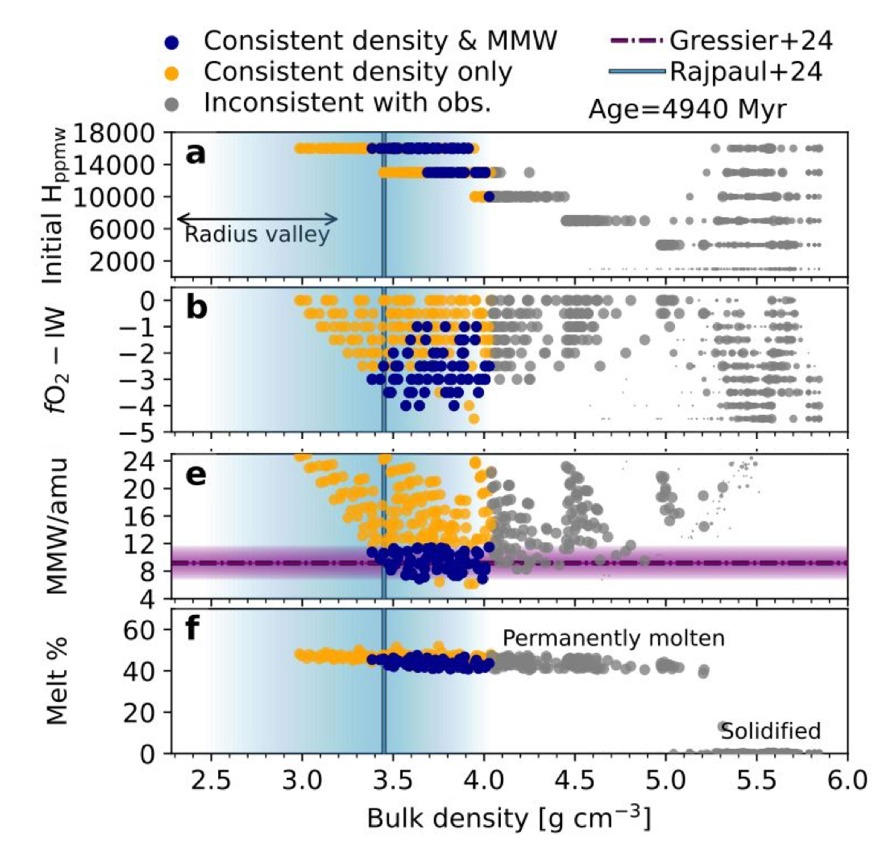
This is where things get interesting. From all scenarios in Figure 1, only a small subset of initial conditions (in blue) is able to reproduce L 98-59 d’s present-day properties. The models that succeed are those that begin with higher hydrogen content (panel a) and lower oxygen content (panel b) in their interiors. When evolved forward in time, these initial states naturally converge toward the observed present-day constraints, including the measured atmospheric mean molecular weight (panel e). They also remain consistent with the planet being not fully solidified, but instead maintaining a long-lived magma ocean today (panel f).
So what kind of planet is L 98-59 d today?
While the successful blue points in Figure 1 already point towards a tightly constrained “birth certificate” for L 98-59 d, the real question is whether these constraints are sufficient to identify what kind of planet L 98-59 d is, and what this might reveal about the wider population of worlds in the “radius valley”.
Among the species identified in L 98-59 d’s atmosphere are sulfur-bearing gases such as hydrogen sulfide (H₂S), which is also found in volcanic environments on Earth. But L 98-59 d turns out to have something of a teenage identity crisis: despite these familiar ingredients, its atmosphere is far from Earth-like, with conditions that place its molecules in a very different chemical and thermal regime. As a result, the authors argue that L 98-59 d does not fit into any of the formation pathways previously associated with the “radius valley”, but instead belongs to an entirely new class of molten worlds with heavy sulfur-based molecules.

To better understand L 98-59 d’s unusual chemistry, the authors looked at how various molecules are distributed throughout the atmosphere, specifically how their relative amounts change with pressure (see Figure 2). What really stands out here is how the solid and dashed lines diverge for the sulfur dioxide (SO₂) species. Nature, as usual, refuses to make things simple: only models that include stellar radiation-driven reactions — where light breaks apart molecules and recombines them — reproduce the observed abundance of SO₂. The detected SO₂ is therefore not simply released from the planet’s interior, but instead formed directly in the atmosphere as a result of photochemical reactions. This implies that the atmosphere of L 98-59 d is an active chemical system continuously reshaped by stellar radiation — still figuring itself out, rather than behaving like a fully “grown-up” atmosphere.
More worlds, more clocks to rewind
Just like human lives, we have seen that exoplanetary histories are complex, messy, and not always easy to reconstruct from the outside. Yet, by combining physical models with present-day observations, we can begin to rewind these histories step by step, using today’s clues to test possible pasts. L 98-59 d shows how far this approach can already take us — from narrowing down birth conditions to its “teenage-like”, still-evolving phase. And the exciting part is that we are only getting better at this. With better upcoming models and more observations, these planetary clocks will become easier to read, until one day, rewinding a planet’s history might feel almost as straightforward as flipping through a biography — all with no time machine required.
Astrobite edited by Drew Lapeer
Featured image credit: Artistic impression of an ultrahot super-Earth, credited to NASA/ESA/CSA/R. Crawford (STScI), licensed under CC BY 4.0.
