
Title: Signatures of a subpopulation of hierarchical mergers in the GWTC-4 gravitational-wave dataset
Authors: Cailin Plunkett, Salvatore Vitale, Thomas Callister, Michael Zevin
First Author’s Institution: LIGO Laboratory & Kavli Institute for Astrophysics and Space Research & Department of Physics, Massachusetts Institute of Technology, Cambridge, MA 02139, USA
Status: Accepted in Physical Review Letters. Preprint available on arXiv.
Impossible black holes?
What happens to a star when it reaches the end of its life depends largely on its mass, but most of them end up turning into a compact object (black hole, neutron star, or white dwarf) after going supernova or shedding their outer layers, preserving a fraction of the dead star’s mass. There is however, in stellar evolution theory, a range of stellar masses (from 130 to 250 solar masses), for which these stars end their life with a particularly odd event: a pair-instability supernova (PISN), which is covered in more detail in this astrobite and that astrobite. PISN are so energetic that the supernova explosion completely disperses the stellar material, leaving behind… no compact object at all. This process leads to a range of black hole masses (from about 45 to 120 solar masses) that just should not be able to form: this is what we call the PISN black hole mass gap.
However, in observations, we still see plenty of black holes with masses in this mass gap. So, what gives? If these black holes aren’t coming from supernovae, then where are they coming from?
Can repeated mergers fill the mass gap?
Apart from the death of a star, black holes can also be formed by the merging of two pre-existing black holes. This commonly occurs when a binary star system turns into a binary black hole (BBH: two black holes closely orbiting each other) once both stars have gone supernova. Over time, the two black holes lose energy through gravitational interactions with other nearby matter (such as stars), and through the emission of gravitational waves — I’ll come back to these shortly. The lost energy causes the orbit of the BBH to shrink, and eventually, they get close enough to merge into a single more massive black hole.
One prevalent theory to explain the existence of black holes in the predicted PISN mass gap suggests that these seemingly impossible black holes could simply have formed from repeated black hole mergers: two first-generation (1G) black holes merge to form a more massive second-generation (2G) black hole, then this 2G black hole merges with another 1G black hole, etc., basically building more and more massive black holes by merging many lighter black holes. When at least one of the black holes in a merger was formed by a prior merger, we call it a hierarchical merger (e.g., 1G+2G). Otherwise, it’s a first-generation merger (1G+1G).
For now, the repeated black hole merger theory is just that: a theory, which requires experimental evidence to support or refute it. One way to test this theory is through the observational detection of hierarchical mergers!
Gravitational waves and black hole spin
A few paragraphs ago I mentioned gravitational waves. Now, I will tell you a bit more about them, and how useful they are to study black hole mergers.
Gravitational waves (GW) are ripples in space-time caused by the relative acceleration of massive objects, such as when two black holes orbit each other. These ripples travel across space at the speed of light, stretching and compressing space as they propagate, and carrying information about their source. When two black holes merge, they emit a GW signal strong enough to be detected by GW detectors here on Earth, which usually consist of a huge interferometer, such as the famous Laser Interferometer Gravitational-wave Observatory (LIGO). We can therefore collect information about BBHs through the measurement of the GW signal from their merger.
The BBH properties you can extract from a GW signal include the masses and the spins of the two black holes that merged. A black hole’s spin is a measure of its rotation on its own axis: it has a magnitude (the rotation speed) and a direction (the orientation of the rotation axis). 1G+1G mergers tend to have two black holes of similar mass with spins aligned with their orbital axis because the two stars (and then black holes) evolved together. Hierarchical mergers, on the other hand, tend to have one black hole much heavier than the other, and more randomly oriented spins due to the dynamics of the previous merger. See the diagram in Figure 1. Therefore, we can differentiate hierarchical mergers from 1G+1G mergers using GW BBH spin and mass data!
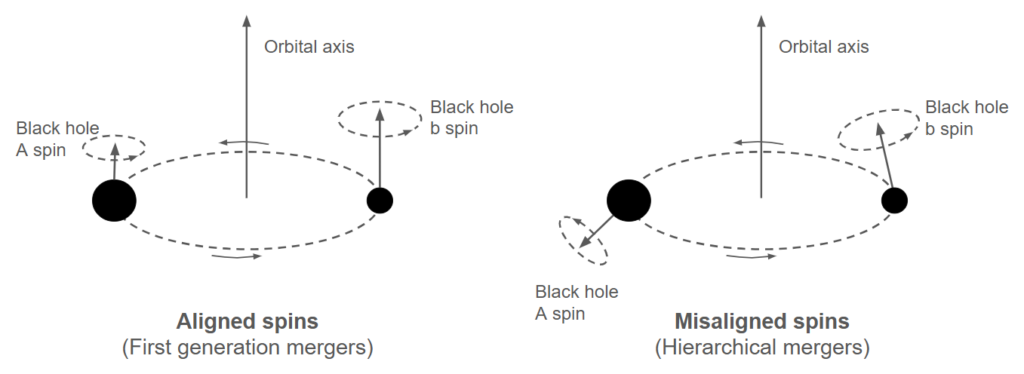
In this paper, the authors use LIGO-Virgo-KAGRA (LVK) Collaboration data from the Fourth Gravitational-Wave Transient Catalog (GWTC-4) to extract mass and spin properties for over 200 BBH mergers.
Binary black hole mixture modelling
To analyze these 200+ merger events and identify hierarchical mergers, the authors use two effective spin parameters: \(\chi_\mathrm{eff}\) and \(\chi_\mathrm{p}\). \(\chi_\mathrm{eff}\) quantifies how aligned the black hole spins are with the orbital axis, while \(\chi_\mathrm{p}\) is related to how parallel the spins are to the orbital plane. These parameters also encode the mass ratio of the two black holes.
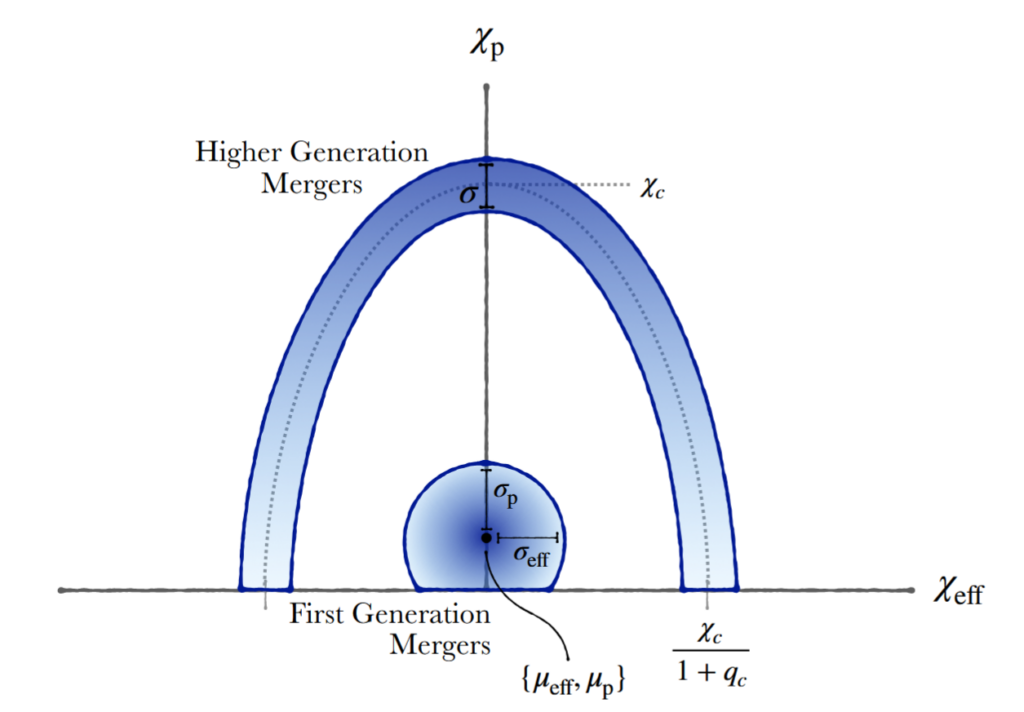
The authors then build two models for the expected distribution of effective spin parameters for a) 1G+1G mergers, and b) hierarchical (most commonly, 1G+2G) mergers. Their full model is then a mixture of these two models, with a “mixture fraction” that represents the fraction of mergers that are hierarchical. Figure 2 shows a schematic of the two components of the mixture model.
Mixture models are really useful when you expect that your data might contain two sub-populations (such as 1G+1G and hierarchical mergers). Fitting your data to a mixture model allows the data to basically sort itself into the sub-populations based on what seems most likely without enforcing the existence of either sub-population.
Mass-varying merger trends
By allowing the “mixture fraction” (AKA, the fraction of hierarchical mergers) to vary as a function of the BBH’s primary (heavier) black hole’s mass, the authors uncover some interesting trends, which can be seen in Figure 3.
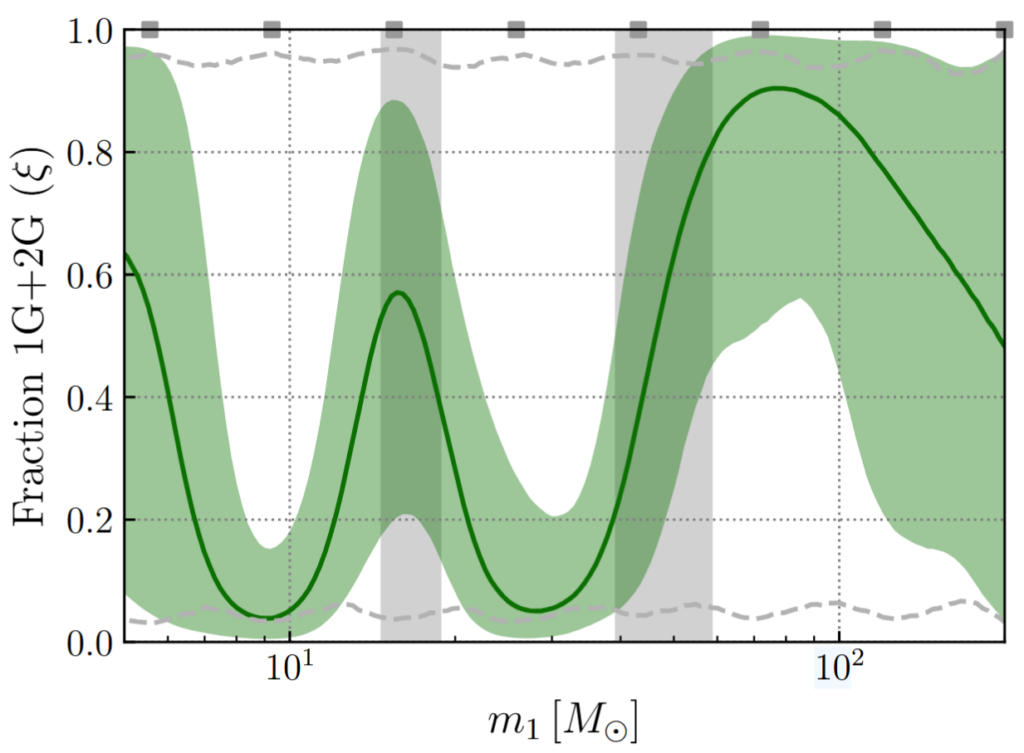
The three main interesting features of Figure 3 are that:
- Most mergers with a primary mass above about 46 solar masses are hierarchical mergers. This corresponds exactly to the expected onset of the black hole mass gap at 45 solar masses! This result implies both that mergers in the mass gap are almost always hierarchical, and that black holes in the mass gap are very likely to be 2G black holes that formed from a previous merger, supporting the theory that repeated merger might fill the mass gap.
- There is a separate lower mass sub-population of hierarchical mergers around 16 solar masses. This feature is attributed to the abundance of 2G black holes of this mass simply due to stellar evolution in a certain type of star cluster.
- There is a lack of hierarchical mergers from 20 to 40 solar masses. What causes this dip is unclear, but it could hint at an increased abundance of 1G black holes at these masses.
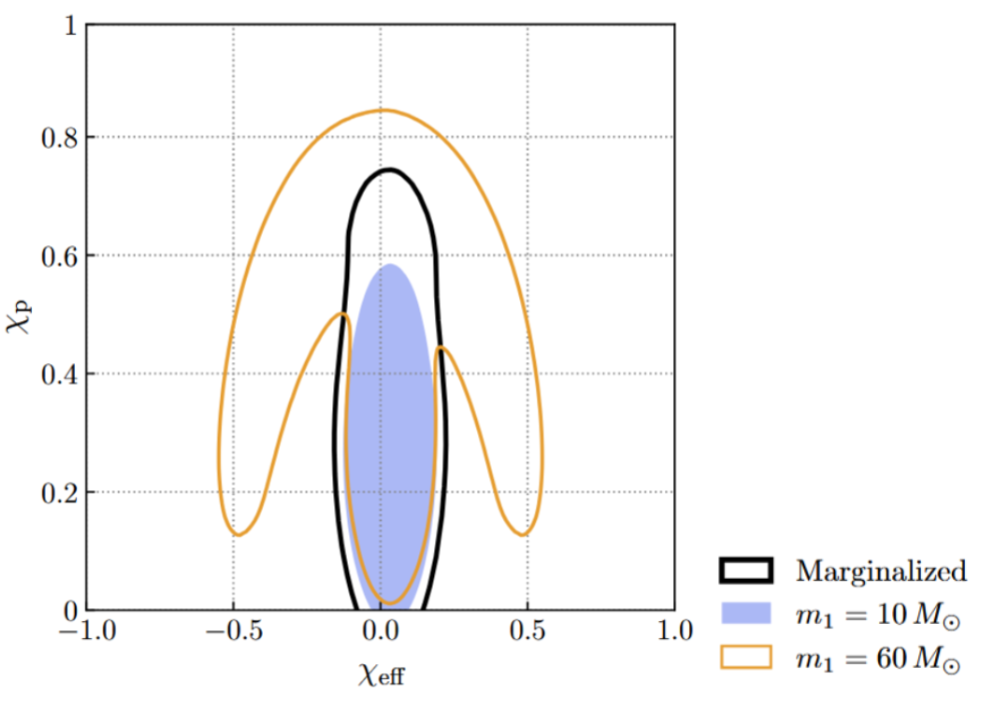
Recalling the schematic in Figure 1, Figure 4 shows more visually how the mixture model that best fits the data changes with primary mass. At low mass (blue shaded region), the merger population is mostly situated in the Gaussian component of the model, indicating a majority of 1G+1G mergers (and 1G black holes). Around 60 solar masses (yellow contour), in the mass gap, the merger population significantly extends to the arc component, indicating a high fraction of hierarchical mergers (and 2G black holes).
What’s new?
Overall, this study confirms the findings from previous studies that modelled only \(\chi_\mathrm{eff}\) (such as the one covered in this astrobite), while also accounting for an additional source of error by incorporating more detailed spin modeling with the inclusion of \(\chi_\mathrm{p}\). This increases confidence in previous results and in the theory that repeated mergers might fill the mass gap. Most of science isn’t about finding something new, it’s about being really confident in what you found!
If you are interested in learning about how the PISN black hole mass gap can be used to study nuclear reaction rates, check out this astrobite.
Astrobite edited by Margaret (Maggie) Verrico
Featured image credit: Original binary black hole image by SXS, the Simulating eXtreme Spacetimes (SXS) project (http://www.black-holes.org), Courtesy Caltech/MIT/LIGO Laboratory. Modified with duplicate overlayed images by Laurie Amen.

Loved reading this. You made it very interesting with your style of writing! Thanks!
Thank you! I’m glad you enjoyed the post! 🙂