
Title: Quantum Limits of Exoplanet Detection and Localization
Authors: Nico Deshler, Sebastiaan Haffert, and Amit Ashok
First Author’s Institution: Wyant College of Optical Sciences, University of Arizona, Tucson, AZ, USA
Status: Published in Physical Review A on April 1, 2026 [open access]
Exoplanets, planets orbiting distant stars shine mostly by reflecting starlight, with a faint thermal glow of their own, leaving them extremely dim when contrasted against their hosts. Astronomers have many ways to detect these tiny worlds from Earth, and their telescopes keep improving — but how far can these improvements ultimately go? This week’s paper investigates the fundamental physical limits standing in the way of detecting exoplanets.
This week’s paper focuses on direct imaging, one of several ways astronomers detect exoplanets. Many planets are found indirectly: the transit method looks for a planet briefly blocking its star’s light, while the radial velocity method measures the star’s tiny wobble, caused by an orbiting planet. Direct imaging is different: astronomers actually take a picture of the planet!
It’s extremely challenging to separate the faint light from the planet itself from the overwhelming glare of its host star, however. To do this, astronomers use what’s called a coronagraph to block the light of the star to just see the planet. Imagine using your thumb to block out the light from the Sun to see better, like seeing the Sun’s corona during a solar eclipse: this is exactly what direct imaging does.
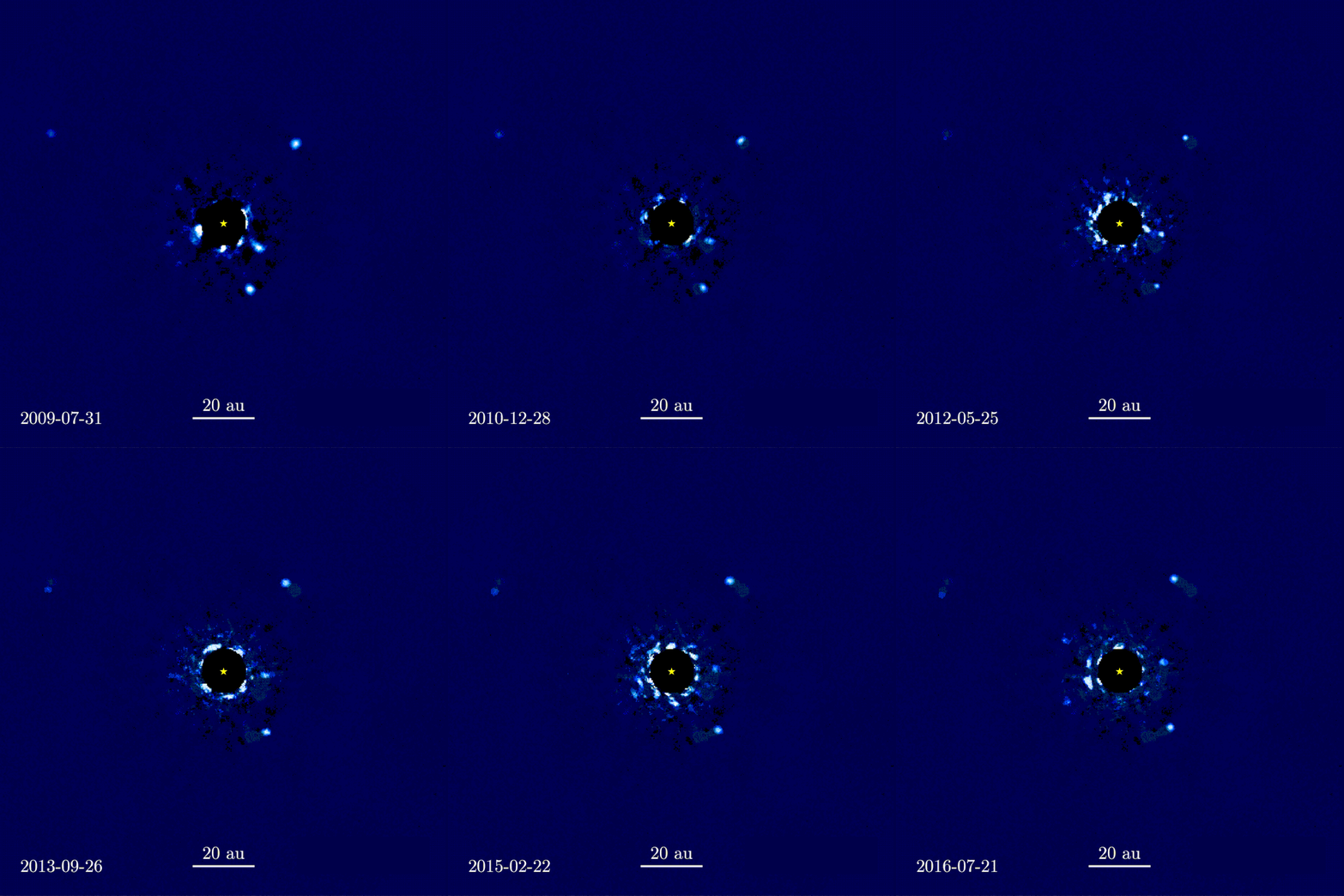
However, coronagraphs are imperfect: sometimes the star’s light still leaks into the image, as seen above in Figure 1. Algorithms can be written to subtract some of the star’s light, but they are imperfect too: in scrubbing away the glare, they can introduce false signals that look like planets, but they aren’t planets at all.
Overall, whether or not direct imaging can detect a planet depends on a number of factors. If the star is way, way brighter than the planet, the planet’s light won’t outshine the star. Similarly, brighter planets are easier to see; oftentimes, younger planets are the brightest at infrared wavelengths as they are still molten and hot from formation. Finally, planets that are farther away from their star are easier to detect: if the planets are too close, the coronagraph will block the planet as well.
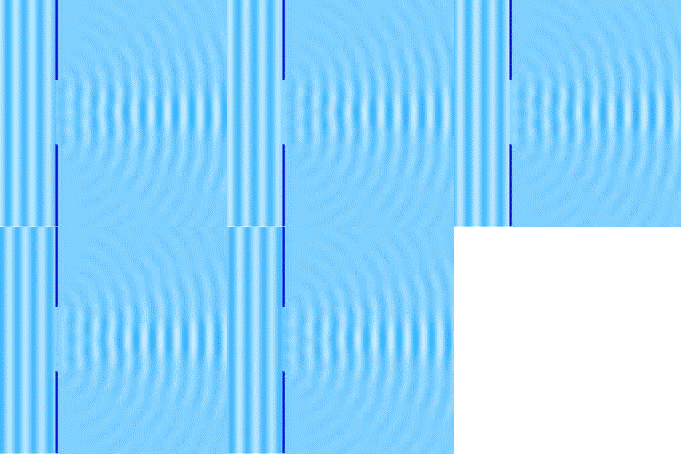
Two fundamental telescope-physics limits are at play: diffraction and photon shot noise. Diffraction is the slight spreading of light as it passes through a telescope’s aperture, like ocean waves fanning out after passing through a gap in a harbor wall; see Figure 2 below. Diffraction sets how close a planet can sit to its star before the planet is lost in the star’s diffraction blur. Photon shot noise comes from light’s particle-like nature. Photons arrive at random times, creating statistical flickering in the measured starlight. It limits how faint a planet can be before its signal is buried in that noise.
This paper models the theoretical limit of direct imaging by treating both constraints together: diffraction, which controls how well a planet can be separated from its star, and photon shot noise, which controls how bright the planet must be to detect.
To find that limit, the authors determine the limits of detection (whether a planet is there at all) and localization (figuring out where the planet is). These limits are not limited by today’s hardware (size of coronagraph, reflectivity of mirrors, etc.) but instead the actual quantum mechanics of light! The question is not whether a particular telescope can be built or operated well enough, but whether an ideal direct-imaging telescope could detect a planet at all.
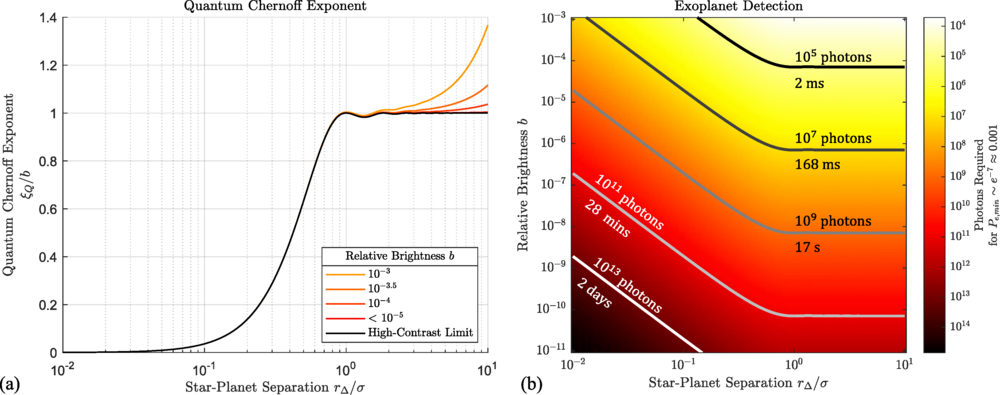
The detection limit means deciding, from the light you’ve collected, whether you’re seeing a star alone or a star plus a planet. This is captured by the quantum Chernoff exponent, which measures how distinguishable the two cases are. A well-separated planet adds a small asymmetric blur, making the fields distinct and the exponent large — but as a planet huddles closer to its star, the two fields become nearly identical. In the extreme case where they’re physically identical, even a perfect telescope could not tell a planet was present, because the difference was never written into the light to begin with. Figure 3 illustrates how star-planet separation changes how distinguishable the planets are.
Distinctness alone isn’t enough, though. The planet also has to deliver enough photons to stand out against the star’s glare. This is where photon shot noise comes in, with the planet’s signal needing to rise clearly above the random flickering we described earlier.
The localization limit is captured by the quantum Fisher information, which measures how sharply the light responds when the planet moves. If a tiny move in the planet produces a clear change in the light, you can locate the planet precisely; if the planet can drift before the light changes, its position is very hard to determine.
So, what did today’s authors find? Nowadays, coronagraphs block a lot of star light, as there is a size limit on how physically large they can be. However, mathematically, it turns out that the detection limit for planets is inside the diffraction blur! This is great news for astronomers: we can keep searching with direct imaging in this area close to a star. Astronomers will just need to observe this area for longer to get a signal. However, the researchers did find that if and when we are able to detect planets within the diffraction limit, we will struggle with the exact localization of the planet.
Finally, why does this research matter? The planets astronomers are most interested in detecting are small, rocky worlds in the habitable zone. These are also the hardest to detect: faint, and hugging their stars. Beyond about 80 light-years, planets in this region sit at or inside the diffraction limit of today’s telescopes, lost in the blur. The encouraging message of this work is that the blur isn’t a fundamental wall. We can see inside the blur with better designed coronagraphs. This work points the way to future telescopes that could still find planets within this blur.
Astrobites edited by Joe Williams.
Featured image credit: https://jasonwang.space/orbits.html
