
Title: Ice Giants Revisited: Uranus and Neptune as Magma Ocean Worlds
Authors: Edward D. Young, Sarah P. Marcum, Aaron Werlen, Paula N. Wulff
First Author’s Institution: Department of Earth, Planetary, and Space Sciences, University of California, Los Angeles, USA
Status: Submitted to The Astrophysical Journal
You’re probably used to seeing tabloids in the checkout aisle of the grocery store claiming all sorts of wild things. Perhaps it’s a celebrity couple who’s about to break up or have a baby. Maybe it’s an exposé on the fiery feud between movie co-stars who just can’t stand each other. It’s even more likely to be some terrible secret that the royal family is desperately trying to cover up. The scandals of life on Earth are abundant, and it seems like the rest of the solar system isn’t any different. Although you might not see their pictures on the front covers of any gossip magazines, Uranus and Neptune may not be what you think. These “ice giant” planets have a piping-hot secret that the authors of today’s paper are exposing.
THE OLD STORY COMES OUT
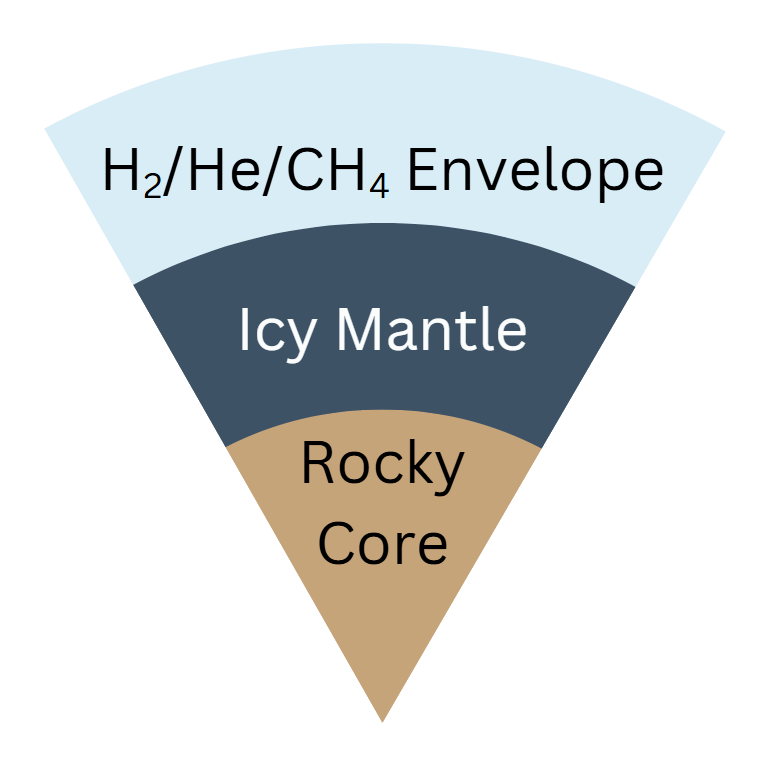
After our Sun formed roughly 4.6 billion years ago, a disk of leftover gas and dust remained around it, called a protoplanetary disk. In the inner hotter part of the disk, elements like iron, silicon, and magnesium coalesced into the small dense rocky planets you know and love today: Mercury, Venus, Earth, and Mars. In the outer colder part of the protoplanetary disk, where water freezes into solid grains of ice, larger planets formed. This includes the gas giants, Jupiter and Saturn, which were massive enough to undergo runaway gas accretion of hydrogen and helium, ballooning up to incredible masses, albeit with overall low densities. Further out still, we find Uranus and Neptune, which are known as “ice giants” due to their intermediate mass and density. Uranus and Neptune have previously been thought to be composed of a rocky core, a middle layer of ices, and an outer layer of hydrogen and helium with trace amounts of methane. But something about this story smells rotten, and it’s not just the methane…
AN ICY CONSPIRACY
Can we really trust what we think we know about the composition of Uranus and Neptune? They are the only two planets that went undetected by humankind until the invention of the telescope, so they have a history of being sneaky. The authors of today’s paper note that the canonical three-layer model of an ice giant’s interior structure as described above, is not the only way to explain the known properties of these two planets. Firstly, their interiors may not be separated cleanly into three distinct compositions, since mixing can occur between the layers. Furthermore, a series of lines of evidence suggests that Uranus and Neptune may not even contain very much ice at all. So much for “ice giant”! The many asteroids and dwarf planets found in the Kuiper belt, which are thought to well represent the material that Uranus and Neptune were formed from, are primarily composed of rock, not ice. Additionally, observations of protoplanetary disks around faraway stars find them to also be ice-poor. When we look to the planets of other stars, we see lots of sub-Neptune sized planets, but their interior structures remain an unsolved problem in astronomy, and it’s unclear whether sub-Neptune exoplanets are ice-poor gas dwarfs or ice-rich water worlds. We reached out to Uranus and Neptune for a comment, but they didn’t get back to us.
MAGMA HOT GOSSIP
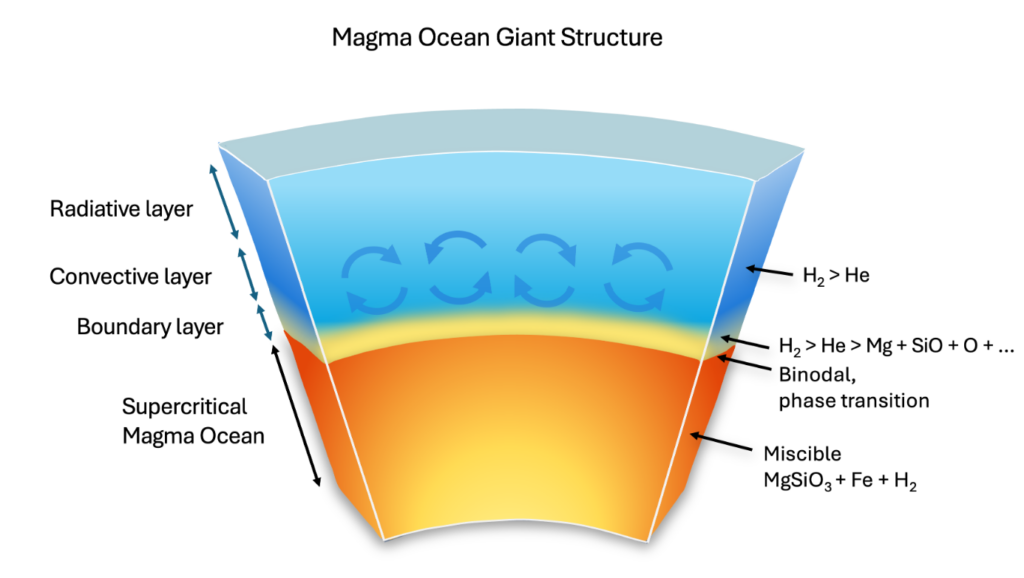
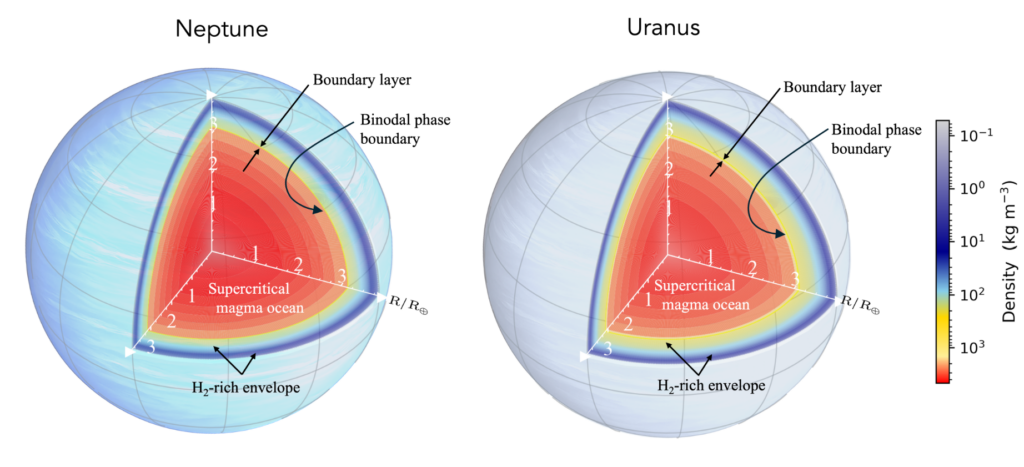
So, if the “ice giants” might not be made of ice, what the Herschel are they made of? The authors of today’s paper explore the possibility of Uranus of Neptune being better described as magma ocean worlds with overlying atmospheres dominated by hydrogen and helium. This possibility is supported by theoretical molecular dynamics simulations, which suggest that at high pressures, hydrogen gas can dissolve into magma, forming a well-mixed fluid. This mixing may explain Uranus and Neptune’s intermediate density, previously interpreted as ices. In this model, there is a transition zone at the surface of the magma ocean (called a binodal), were molten silicate rock separates from the hydrogen and rains back down into the magma ocean. Above the binodal, the composition becomes almost entirely hydrogen and helium with no remaining rocky material.
INSIDERS REVEAL
How well does this model match real-life observations? The authors check to see if their magma ocean model can reproduce six key properties of Uranus and Neptune, many of which were measured precisely by the Voyager 2 mission. The properties are:
- the radius corresponding to 1-bar of pressure
- the temperature corresponding to 1-bar of pressure
- the moment of inertia (how the planet’s mass is distributed from its centre)
- the intrinsic luminosity (how much heat comes up from the planet’s interior)
- and two gravitational harmonics correction terms (coming from the fact that the planets aren’t perfect spheres)
The authors use a Markov-Chain Monte-Carlo (MCMC) algorithm to predict the values of three parameters that simultaneously reproduce all six observed properties. Those three parameters are:
- the total mass hydrogen fraction of the planet
- the pressure at the transition zone from magma ocean to gas envelope
- and the strength of convection in the gas envelope
This interior structure model is simple in the sense that it only has three free parameters, but complex enough to capture important physical effects like the planets’ rotation and winds.
THE SHOCKING TRUTH
Overall, this magma ocean model reproduces the observable properties of Uranus and Neptune well. The only exception is Neptune’s 1-bar temperature, which is overestimated, likely due to large uncertainties in the opacity assumed for the atmosphere. Additionally, this model of a magma ocean world provides elegant explanations for many of the unique features of Uranus and Neptune. For example, Uranus’ ultra-low intrinsic luminosity (basically no heat coming up from the interior) can be naturally explained by strong chemical gradients at the transition zone that suppresses heat flow due to convection. Also, the lack of ammonia observed in the atmospheres of both planets can be easily explained by the fact that ammonia dissolves readily into magma oceans, pulling it out of the atmosphere.
It should be noted that this is one of several models that can successfully describe the observed properties of Uranus and Neptune. This model does have its advantages though, such as the fact that it has a small number of free parameters (only three) making it easier to test and less prone to overfitting. It also assumes that Uranus and Neptune are made of similar material to gas dwarf exoplanets, suggesting they’re scaled down versions of Jupiter and Saturn. How cute!
So next time you’re looking at the tabloids as you checkout at the grocery store, consider the possibility of a magma ocean scandal on Uranus and Neptune. Planetary scientists can make shocking reveals too, just like the paparazzi.
Astrobite edited by Elise Koo
Featured image credit: NASA, edited by Evan Nelles Henderson.

This Astrobite is what the stores should be stocking! Most engaging, entertaining, and informative article I’ve read in ages.