by Guest | Oct 27, 2015 | Daily Paper Summaries
More than 100 massive stars orbit the supermassive black hole at the center of our galaxy incredibly closely.
by Guest | Jul 27, 2015 | Daily Paper Summaries
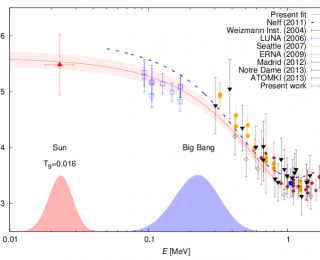
Solar neutrinos constrain the origin of the elements in the Big Bang.

by Guest | Dec 14, 2014 | Quick Notes
Astronomer & Startorialist blogger Summer Ash brings us a holiday gift guide for the stylish and savvy star-lovers in all our lives.

by Guest | Oct 29, 2014 | Current Events
One at a time, street by street, town by town, we can save the sky.
by Guest | Oct 24, 2013 | Daily Paper Summaries
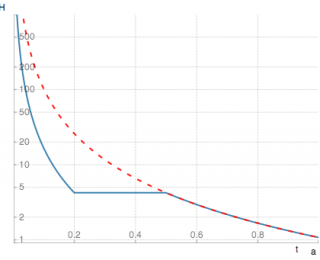
Today’s post is a guest contribution from Dr. Andrew Pontzen, a Royal Society University Research Fellow at University College London and an expert in galaxy formation and cosmology. Andrew is also a leader in the use of fantastic visualizations and interactive graphics as explanatory and teaching tools, and in this post he uses this approach to provide a new look at the cosmological concept of inflation. Loading the post. If this message doesn’t disappear, please check that javascript is enabled in your browser. Cosmic inflation is a hypothetical period in the very early universe designed to solve some weaknesses in the big bang theory. But what actually happens during inflation? According to wikipedia and other respectable sources, the main effect is an ‘extremely rapid’ expansion. That stock description is a bit puzzling; in fact, the more I’ve tried to understand it, the more it seems like inflation is secretly all about slow expansion, not rapid expansion.The secret’s not well-kept: once you know where to look, you can find a note by John Peacock that supports the slow-expansion view, for example. But with the rapid-expansion picture so widely accepted and repeated, it’s fun to explore why slow-expansion seems a better description. Before the end of this post, I’ll try to recruit you to the cause by means of some crafty interactive javascript plots. A tale of two universes There are many measurements which constrain the history of the universe. If, for example, we combine information about how fast the universe is expanding today (from supernovae, for example) with the known density of radiation and matter (largely from the cosmic microwave...
