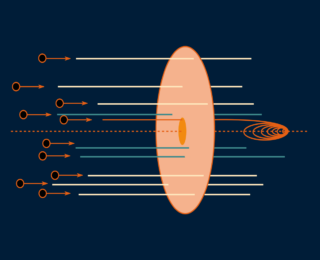
Looking through the eccentricity pinhole
Only a tiny fraction of black hole binaries produce gravitational waves with measurable eccentricity. What does the eccentricity distribution tell us about how these binaries formed?

Only a tiny fraction of black hole binaries produce gravitational waves with measurable eccentricity. What does the eccentricity distribution tell us about how these binaries formed?

Moons are abundant within our own solar system, but astronomers have historically struggled to find moons (exomoons) within other systems beyond our own. Yet, today’s authors suggest that the James Webb Space Telescope may be the key for solving this missing exomoon problem.

Today’s authors propose upgrades to the VLTI that will allow us to search for signs of life on distant worlds.

If you have a cosmic mystery on your hands, surely it helps to examine it from as many angles as possible? Today’s authors do that, literally, while investigating the highest-energy particles in the universe.
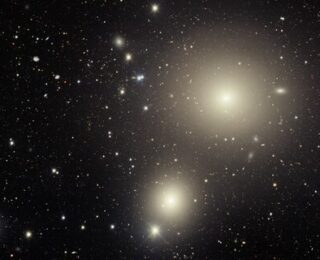
Galaxy clusters are collections of galaxies that are bound together by gravity. They are the largest structures that exist in our Universe, and their mass is dominated by the hot gas that lies between galaxies called the intracluster medium. One of the closest galaxy clusters is Fornax, and it was recently studied in detail using the MeerKAT radio telescope in South Africa. This bite dives deep into a study of the magnetic field of this cluster and the implications the results have of our understanding of clusters of galaxies.

What do a galaxy’s stellar clumps tell us about how it formed? Today’s guest author Michelle Park explores interesting properties of clumps from the FIRE simulations.