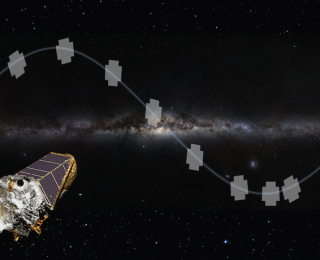
by Michael Zevin | Jan 12, 2015 | Daily Paper Summaries
The Kepler Space Telescope was the workhorse of exoplanet discovery until its second reaction wheel failed, rendering it incapable of continuing its original mission. Now, Kepler is back in the game of planet hunting.
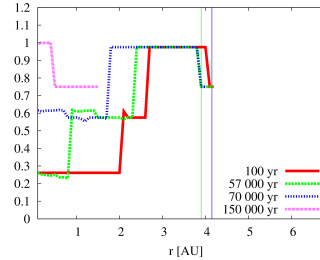
by Tim Lichtenberg | Jan 2, 2015 | Daily Paper Summaries
The recent discoveries of alien worlds seemingly rich in carbon reveal a lot of diverse information about the history and further evolutionary paths of exoplanets. However, a correct physical understanding of the investigated systems is crucial for getting the most out of incoming data and is an area of very active research. Therefore, the theoretical modeling of exoplanetary systems must be advanced to a state which includes the long-term evolution of the distribution of detectable molecular species in the planet forming environment.
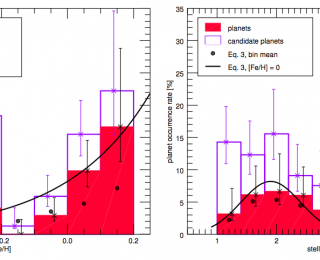
by Ruth Angus | Jan 1, 2015 | Daily Paper Summaries
Are more massive stars more likely to have planets? Read on to find out…
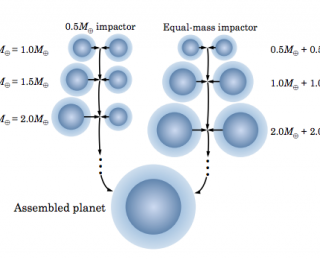
by Jaime Green | Dec 31, 2014 | Daily Paper Summaries
Super-Earths could form close-in to their stars… but what about their atmospheres?

by Ashley Villar | Dec 30, 2014 | Daily Paper Summaries
Dark matter, neutron stars, black holes, and an extremely exotic explanation for Fast Radio Bursts.
by Anson Lam | Dec 29, 2014 | Daily Paper Summaries
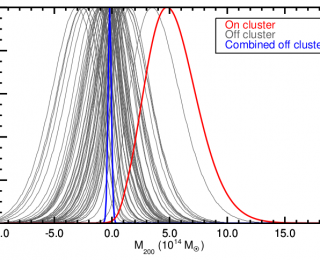
Measuring CMB distortions caused by gravitational lensing is a unique way of estimating galaxy cluster masses.
