by Meredith Rawls | Jan 22, 2015 | Daily Paper Summaries
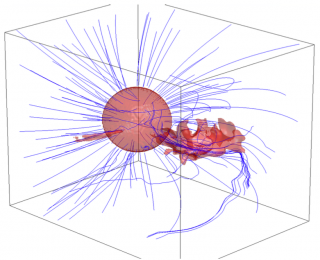
In today’s paper, Čechura and Hadrava examine what happens to the runaway gas from the surface of massive stars—the stellar wind. In particular, they look at systems with massive stars so close to a companion neutron star or black hole that the stellar wind is jarred into a new orbit and heated to the point of emitting X-rays.
by Caroline Huang | Jan 20, 2015 | Daily Paper Summaries
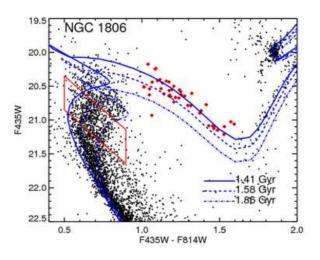
Can stellar clusters be host to multiple star formation events? The authors of today’s paper take a closer look…
by David Wilson | Jan 19, 2015 | Daily Paper Summaries
For years astronomers have wondered if there might be more planets in the Solar System, far beyond the orbit of Neptune. Although we now know for certain that there are no large gas giants left to be discovered, a recent finding has prompted the authors of this paper to propose the existence of not one, but two smaller planets in the outer Solar System.
by Stacy Kim | Jan 16, 2015 | Daily Paper Summaries
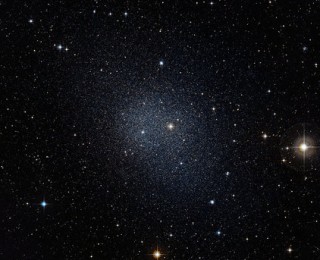
Dwarf galaxies have long been vaunted a useful probe for dark matter physics due to their high dark matter content. But is this true for all dwarfs, particularly the smallest ones? And can the minority baryons affect dark matter signatures?
by Jesse Feddersen | Jan 14, 2015 | Daily Paper Summaries
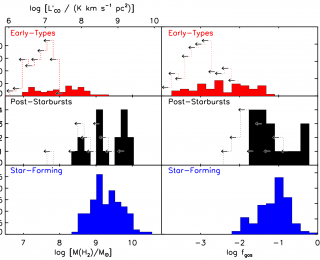
What makes galaxies stop forming stars? Is gas removed entirely, or simply heated to prevent stars from forming? Today’s paper uses observations of carbon monoxide in post-starburst galaxies to try to answer this question.

by Michael Küffmeier | Jan 13, 2015 | Daily Paper Summaries
Magnetic fields are a crucial part of star formation. Read on whether and how the magnetic field strength dissipates during the early collapsing phase.
