by Nick Ballering | Feb 3, 2014 | Daily Paper Summaries
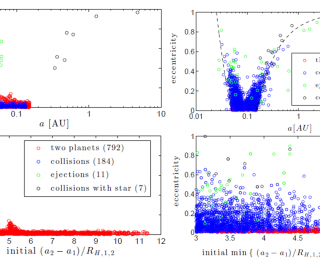
New dynamical simulations show that close-in planets on eccentric orbits can arise from planet-planet scattering — but only if the scattering occurs on larger orbits and is followed by inward migration.
by Elisabeth Newton | Feb 1, 2014 | Daily Paper Summaries
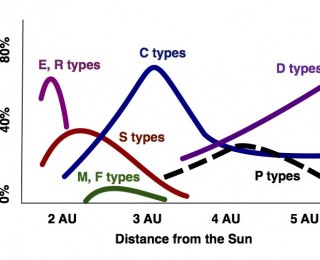
Title: Solar System evolution from compositional mapping of the asteroid belt Authors: F. E. DeMeo and B. Carry Institution: Harvard University, MIT Status: Published in Nature ReviewsIn the 1980s, astronomers and planetary scientists thought the Solar System was a well-ordered place. Planets formed in circular orbits and stayed there. The compositions of the planets were dictated by the composition of the disk of gas and dust out of which they formed. The materials in the disk available to form both planets and asteroids varied with radial distance because it was hotter closer to the Sun. This in turn neatly explained the architecture of the inner and outer Solar System. The same picture made sense when scientists looked at asteroids: asteroids of different compositions (types) were grouped together at different distances from the Sun (Figure 1). Asteroids, like planets, were thought to have formed in one part of the Solar System and stayed there.As new observations have been made, we’ve had to revise the 1980s picture of ordered planet formation. Efforts to explain the structure of our Solar System drove the community to adopt a more chaotic view of planet formation, one in which planets’ orbits can change dramatically and smaller bodies like asteroids can be flung about. One highly influential and successful model for planet migration in the Solar System, the Nice model, has the giant planets undergoing rapid migration and scattering smaller objects throughout the Solar System.Our knowledge of the composition and distribution of asteroids has developed along with theories of planet migration. A decade ago, a few rogue asteroids were known to be “polluting” the main asteroid belt: while located in...
by Justin Vasel | Jan 31, 2014 | Daily Paper Summaries
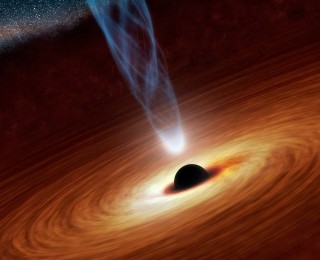
Stephen Hawking proposes that black holes may not have definite event horizons, meaning they’re really more like “gray” holes.
by Korey Haynes | Jan 29, 2014 | Daily Paper Summaries
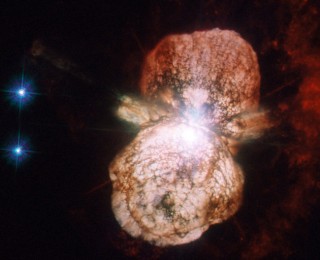
The massive star Eta Carinae has been observed in the infrared for over forty years. Between 1976 and 1998, astronomers saw a linear increase in the star’s brightness. But Eta Carinae has been steadily heating up ever since a close approach with its companion star in 1998, and astronomers want to know why.
by Jessica Donaldson | Jan 28, 2014 | Daily Paper Summaries
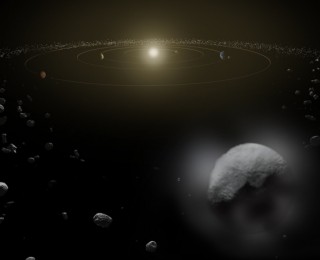
Large plumes of water vapor were recently found on the dwarf planet Ceres in the asteroid belt. Using Ceres’ rotation, astronomers have located two possible sources for the water vapor on the surface.
by Anson Lam | Jan 27, 2014 | Daily Paper Summaries
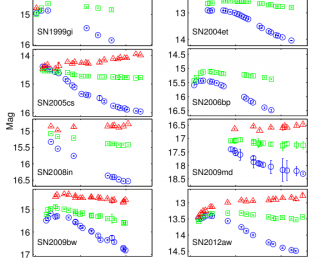
By examining their expansion rate over time, Type II supernovae provide a way to measure extragalactic distances.
