by Yvette Cendes | Jan 24, 2014 | Daily Paper Summaries
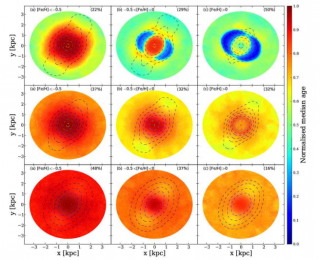
The recent discovery of young stars in the Milky Way’s galactic bulge have raised new questions about galaxy formation. In this paper, a new simulation shows that such stars could be an outcome of natural evolution in the disc over time.
by Becky Smethurst | Jan 23, 2014 | Daily Paper Summaries
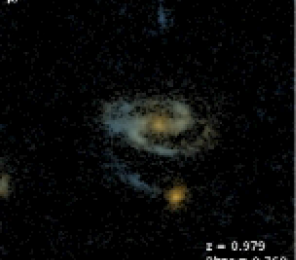
Astronomers have long wished to probe the number of galaxies containing bar structures to ever increasing redshifts. This paper discusses the first results from the Galaxy Zoo Hubble classifications of galaxies out to redshifts of z = 1, in order to study how the fraction of galaxies containing a bar has changed over a cosmic time that has previously not been explored.
by Brett Deaton | Jan 22, 2014 | Daily Paper Summaries
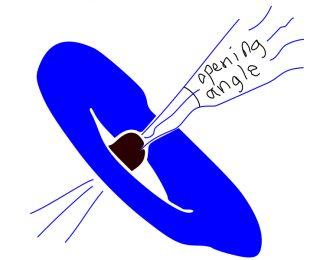
Null data are still data! Chen & Holz use a lack of detections to place a lower limit on the beaming angle of SGRBs.
by Josh Fuchs | Jan 21, 2014 | Daily Paper Summaries
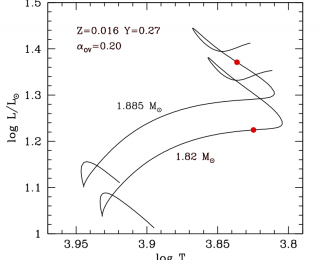
Kepler finds a new binary system with a Delta Scuti pulsator.
by Andrew Emerick | Jan 20, 2014 | Daily Paper Summaries
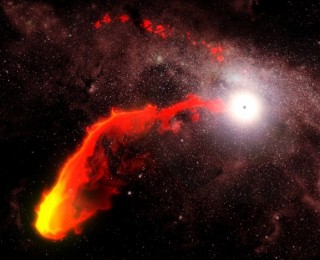
The black hole at the center of our galaxy, Sgr A*, is a very picky eater. However, with the discovery of the G2 cloud, astronomers have had the opportunity to watch the infrequent feeding process in Sgr A* in action. While the origin of this cloud is still debated, research is beginning to suggest that G2 is a gas cloud that was ripped away from a giant star in orbit around our galaxy’s central black hole.
by Erika Nesvold | Jan 18, 2014 | Daily Paper Summaries
Title: Superhabitable Worlds Authors: René Heller and John Armstrong First Author’s Institution: McMaster University Status: Published in Astrobiology Note: This journal article covers two topics that we thought each deserved its own astrobite. Yesterday’s astrobite discussed the first half of the paper, about the effects of tidal heating on habitability. Today’s astrobite explores the concept of superhabitability.Introduction to SuperhabitabilityLet’s talk about the Copernican principle. This idea states that we (humans, Earth, the Solar System, etc) are not special. We’re not the center of the universe, and there’s no particular reason to believe that we’re unique in the Universe. We’re just average, middle-of-the-road, ordinary. In a lot of cases this has turned out to be true — Earth is not the center of the Solar System, the Solar System is not the center of the Galaxy, and the Milky Way Galaxy is only one of many. So this concept is really useful when trying to understand cosmology, but what does it mean in the context of our search for habitable worlds? The Copernican principle would imply that the reason life exists on Earth is not because Earth is a unique, magical place. Instead, life exists on Earth because Earth happens to have the right physical conditions to allow life to evolve, and those physical conditions probably exist elsewhere, too. So our search for “habitable” worlds is often conflated with a search for “Earth-like” worlds — planets and moons with the same size, density, and surface temperature as Earth.But what if we’re not average? What if Earth isn’t your standard suburb of habitability, but actually a rough neighborhood, habitable-but-only-barely? In an...
