by Erika Nesvold | Jan 17, 2014 | Daily Paper Summaries
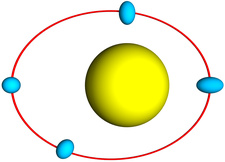
Today’s paper is too awesome to be contained in merely one astrobite, so we’ve split it into two parts. In Part 1, find out how you can keep warm even if you’re far outside your star’s habitable zone (if “you” are a planet or moon, that is). Tune in tomorrow for Part 2: Superhabitability and You!

by Elisa Chisari | Jan 15, 2014 | Daily Paper Summaries
There might be more information in the Hubble diagram of supernovae than we first thought. Far away supernovae are subject to gravitational lensing and in the upcoming decades, they could be used to determine how much matter there is in the Universe and how it clusters.
by Meredith Rawls | Jan 14, 2014 | Daily Paper Summaries
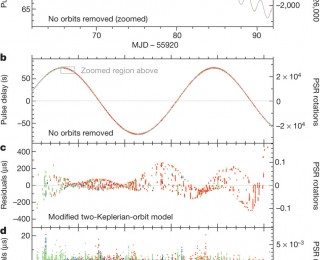
One of nature’s best clocks is a millisecond pulsar. These exotic stellar corpses are neutron stars: incredibly dense, rotating hundreds of times per second, and emitting powerful jets or beams of light. This creates a “pulsing” effect, much like a lighthouse.

by Ben Montet | Jan 13, 2014 | Daily Paper Summaries
Astronomers are used to “looking back in time” when they view distant stars and galaxies. The authors of this paper take a different look back in time and search the internet for evidence of time travelers.

by Joseph O'Rourke | Jan 10, 2014 | Classics
In the final months of World War II, Vannevar Bush, director of the Office of Scientific Research and Development, prepared a report that would forever shape federal support of scientific research.
by Chris Faesi | Dec 31, 2013 | Daily Paper Summaries
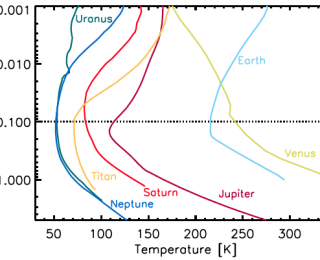
A new model explains the common 0.1 bar temperature minimum in certain types of planetary atmospheres.
