by Allison Strom | Apr 13, 2013 | Daily Paper Summaries
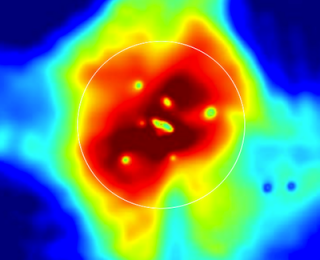
Moving mesh code AREPO looks like it will help astronomers understand the physics of galaxy formation and evolution better than its predecessors, due to an innovative new method of solving the fluid dynamics equations in astrophysical settings. This paper discusses the differences between AREPO and another code called GADGET in the case of gas accretion onto galaxies.
by Lucia Morganti | Apr 12, 2013 | Daily Paper Summaries
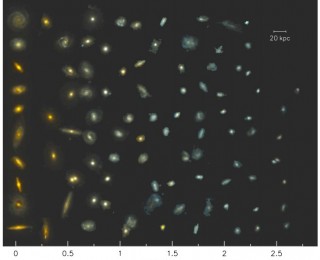
The central question of this Letter is how and when the Milky Way assembled its stellar mass. This issue is addressed by tracing the formation history of spiral galaxies which closely resemble the Milky Way.
by Sukrit Ranjan | Apr 10, 2013 | Daily Paper Summaries
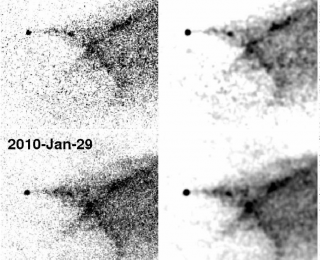
Paper Title: Dynamics of Large Fragments in the Tail of Active Asteroid P/2010 A2 Authors: Jessica Agarwal, David Jewitt, and Harold Weaver First Author’s Affiliation: Max Planck Institute for Solar System Research, Germany Journal: The Astrophysical Journal (Accepted) IntroductionIn January 2010, the LINEAR survey make a remarkable detection: it discovered an asteroid with a long, X-shaped trail (see Figure 1). Dynamical analysis of the tail (analyzing its orbit and stability) indicated the tail had been formed in a single event around nine months prior to the January 2010 observation. This is very exciting: by studying this object, it’s possible, for the first time, get a direct observational handle on the process of asteroid disintegration! This is very important to understanding the evolution of the population of small asteroids in our solar system, as well as to understanding the formation of meteoroid streams which give rise to regular meteor showers like the Leonids. Such studies are particularly important in light of recent initiatives by private industry and NASA towards mining asteroids. Figure 1: Hubble Space Telescope (HST) image of the active asteroid P/2010 A2. The asteroid is the dark dot on the left. The tail is the material on the right, demarcated by an X-shape. The tail seems almost detached from the asteroid, an indication (along with the dynamical analysis) that it originated in a discrete, recent event. MethodPrevious work had indicated either a collisional (something smashed into the asteroid) or rotational (the asteroid spun itself apart) origin for the tail. In this paper, the authors took many Hubble Space Telescope (HST) images of the asteroid over time, starting in January 2010, to...
by Ben Montet | Apr 5, 2013 | Daily Paper Summaries
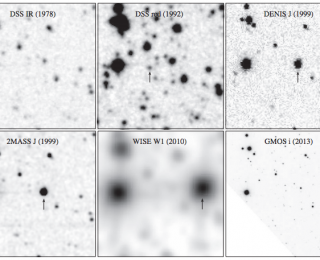
A new brown dwarf system has been discovered only 2 parsec away; Gillon et al. analyze its light curve to study clouds on the surfaces of these stars.
by Erika Nesvold | Apr 4, 2013 | Daily Paper Summaries
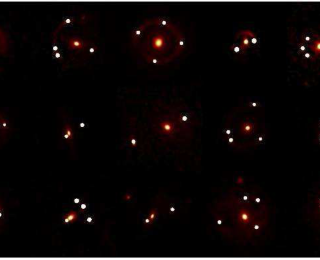
Based on galactic rotation curves, we think that spiral galaxies are embedded in massive dark matter halos. Is the same true for elliptical galaxies? Magain and Chantry use gravitational lensing to measure the mass-to-light ratios in 15 elliptical galaxies, and the results might surprise you!
by Anna Rosen | Apr 3, 2013 | Daily Paper Summaries
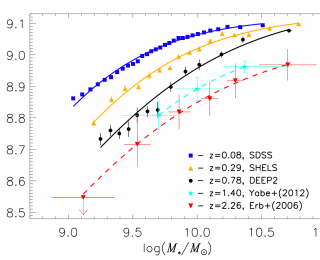
In this article, the authors measure the stellar mass-metallicity relation for star forming galaxies ranging to z~2.3. They find that mass-metallicity relationship for these galaxies evolves with time and also that it flattens at late times.
