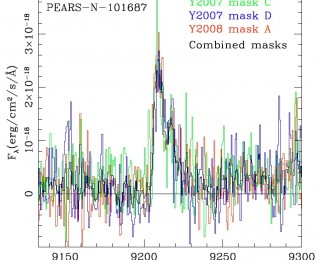
Finding Galaxies at the Edge of the Universe
How can we find the distant galaxies that were responsible for bringing us out of the cosmic dark ages?

How can we find the distant galaxies that were responsible for bringing us out of the cosmic dark ages?
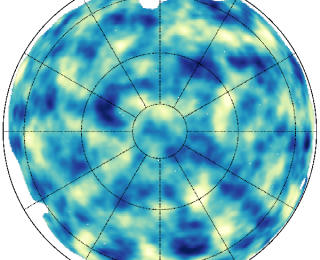
In today’s astrobite, we continue our overview of the papers from the Planck 2013 release. This time, we review papers XVII and XXIII, which discuss weak gravitational lensing of the Cosmic Microwave Background, and the isotropy of the Universe at the time this background radiation was emitted.

Spectroscopy with Herschel can probe the dust in the heart of protoplanetary disks through the 69 micron feature of forsterite. Examining these features in detail reveals that the dust grains are small, iron poor, and confined to narrow rings.
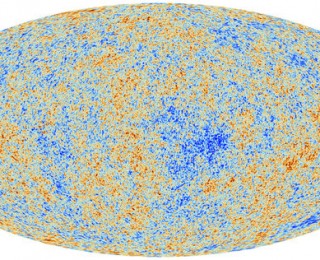
The primordial seeds of the Universe, the Cosmic Microwave Background, have been measured by the Planck satellite with unprecedented precision. In this post, we summarize some of their results on cosmological parameters and primordial non-gaussianity.
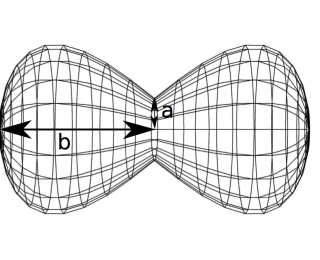
Novae are thermonuclear explosions that occur on the surface of a white dwarf following the accretion of matter from a nearby companion star. The authors seek to understand the geometry and velocity of the ejected material.
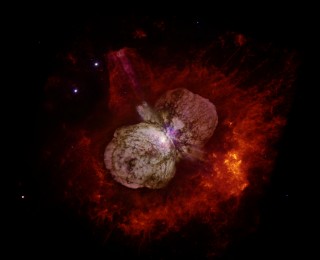
When the supernova impostor SN2009ip brightened to a V-band absolute magnitude of -17.7 near the end of 2012, the outburst was classified as a Type IIn supernova and many observers thought the star had finally exploded for good. In this paper, however, the authors present several months of multiband imaging of transient 2012b and argue that the low limit on the nickel mass and lack of most heavy elements in the ejecta suggest the progenitor is still around, and that transient 2012b was produced instead by the collision of two massive shells, possibly ejected by the pulsational pair instability.