
Grab the vacuum cleaner… it’s cosmic DUST!
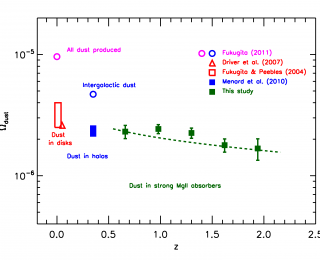
Dust is really ubiquitous in the Universe: it is everywhere from our Solar System to stars and the interstellar medium. However, the observations of dust in galaxies fall short of the prediction of how much dust there is in the Universe. In this work, the authors try to alleviate this problem by estimating the amount of dust present in clouds of gas that inhabit galaxy halos while they look for clues regarding the origin of these clouds.
A Universal Clock Skewed by … Asteroids?
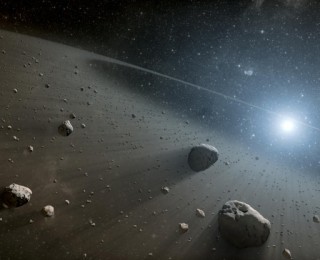
We’ve detected planets around pulsars before, but this pulsar has an even stranger signal. Could it be due to an asteroid belt similar to the one in our solar system orbiting it?
Cleaning Up The Solar System
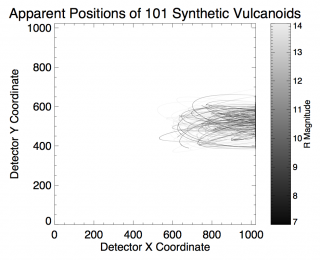
TITLE: A Search for Vulcanoids with the STEREO Heliospheric Imager AUTHORS: A. J. Steffl, N. J. Cunningham, A. B. Shinn, D. D. Durda, S. A. Stern FIRST AUTHOR’S INSTITUTION: Southwest Research Institute, BoulderThe recent evidence for an asteroid belt in the Vega system highlights how well we’re getting to know the solar systems around other stars. But there are some surprising gaps in our knowledge of our own. Inwards of the orbit of Mercury, there exists a dynamically stable region between about 0.21 AU and 0.07 AU where objects can orbit without being perturbed by Mercury or vaporized by the Sun. As far back as 1859 astronomers proposed that there might be at least one small planet lurking in this region, at the time a potential explanation for the odd precession of Mercury, and gave this hypothetical world the name “Vulcan”. Although Mercury’s orbital behavior was later explained by Einstein using general relativity, the idea of close-in planetesimals called “Vulcanoids” stuck around. The orbital motions of Mercury, Venus, and the Sun rule out a planet, but there’s still room for smaller objects. We now know that many, many exoplanet systems feature full-blown planets that orbit far closer in to their stars than Mercury does to the Sun. Why not some debris in ours?But how could something comparatively right next door go undetected for so long? Their very closeness to the Sun makes them hard to see. From Earth’s perspective, objects in the Vulcanoid region never stray farther than about 12 degrees from the Sun in the sky. From the ground they can only be observed in the early twilight, and...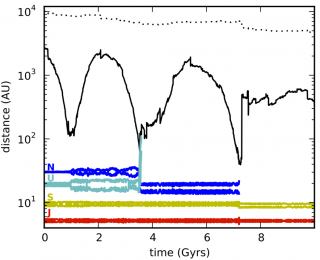
When Push Comes to Shove: How Wide Binaries Can Wreak Havoc on Planetary Systems
New simulations show that — due to forces from outside the stellar system — wide stellar binaries may disrupt planets much more than previously thought.
The Curious Case of Andromeda’s Satellites
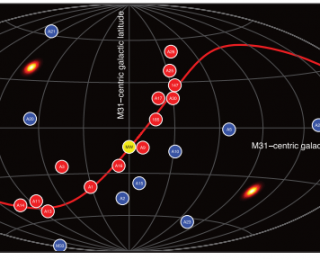
The authors have identified several satellite galaxies confined to a plane in their orbits around our nearest neighbor, the Andromeda Galaxy. Such a planar structure is perhaps at odds with our current understanding of galaxy formation.