by Ian Czekala | Nov 17, 2011 | Daily Paper Summaries
I’m sure you’ve heard the expression “5 hours in the library can save 5 months in the lab.” It’s true. Productive scientists are aware of what other scientists have done before them, that way they may “stand on the shoulders of giants” so that they might see farther. Linking datasets to papers improves the usability of previously published research and is one major way to increase the overall productivity of the scientific field.

by Sukrit Ranjan | Nov 16, 2011 | Daily Paper Summaries
Paper title: Jupiter: Friend or Foe IV: The Influence of Orbital Eccentricity and Inclination (arXiv:1111.3144) Authors: J. Horner, B. W. Jones First Author’s Affiliation: University of New South Wales, Sydney, Australia MotivationThe hunt is on to find habitable exo-Earths, but what does “habitable” actually mean? The traditional definition of habitability focuses on the surface temperature of the planet: specifically, is it in the correct range to support liquid water? However, there are many other components to habitability. For example, if the star is too active and the planet too close to it, stellar activity and radiation may create a hostile environment for life to form. Another constraint on habitability comes from meteorite impacts: if the planet is hit by the equivalent of a Yucatan impactor (i.e. the one that killed the dinosaurs) every few millenia, it will be challenging for complex life to evolve there!In this paper, Horner and Jones focus on the impactor constraint for habitability. The existence of Jupiter is often cited as a factor in Earth’s habitability because the larger planet gravitationally shields Earth from most asteroid and cometary impacts. However, Jupiter is on a very sedate, low-eccentricity, low-inclination orbit, and the search for exoplanets has turned up gas giants with a wide range of inclinations and eccentricities. How would varying the eccentricity and inclination of Jupiter affect the impact rate on Earth? This is the question this paper asks. By understanding the influence of co-systemic giant planet eccentricity and inclination on the rate of impacts onto potentially habitable planets, it will be possible to more tightly focus the search for habitable exoplanets on systems that...
by Nathan Sanders | Nov 14, 2011 | Daily Paper Summaries
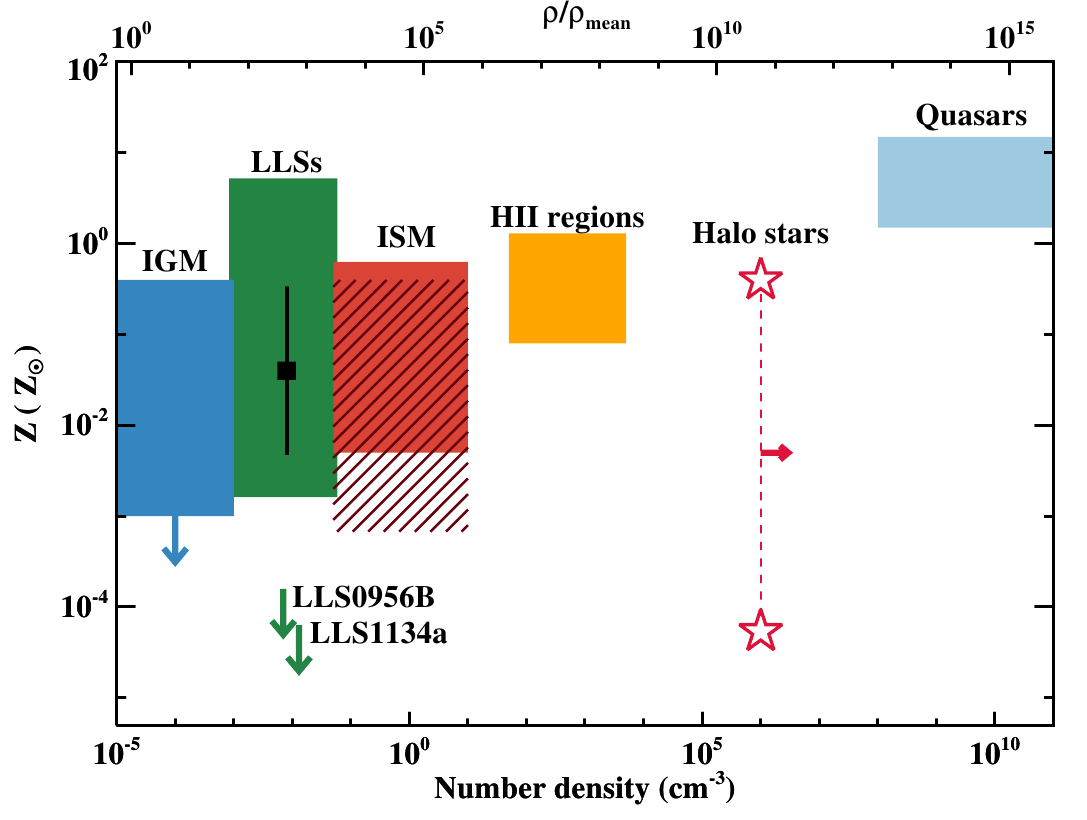
Fumagalli et al. may have observed the first example of metal-free gas untouched after the Big Bang.
by Nathan Goldbaum | Nov 13, 2011 | Daily Paper Summaries
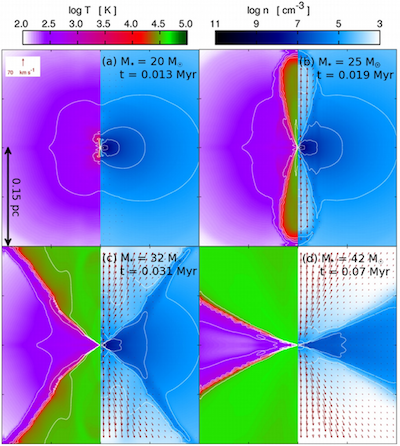
Paper title: Protostellar Feedback Halts the Growth of the First Stars in the Universe Authors: Takashi Hosokawa, Kazuyuki Omukai, Naoki Yoshida, Harold W. Yorke Author’s Affiliation: Jet Propulsion Laboratory; Department of Physics, Kyoto UniversityThe problem of understanding the formation and evolution of the first to form stars in the universe lies at the intersection of many fields of astrophysics. Since the first stars could only have formed once their host dark matter halos had begun to collapse, one must understand the formation of these stars in a cosmological context, tracking gas from extremely low intergalactic densities (~10-27 g cm-3), to extremely high, stellar densities (~1 g cm-3). Since all the metal content of the universe had not yet been synthesized in the cores of stars, the gas that collapsed to form the first stars would have been metal-free and thus possessed very different thermal properties compared to the interstellar and intergalactic gas in the local universe that can cool via metal line emission.Many studies of first star formation have focused on the cosmological piece of the puzzle: starting with a simulation of cold dark matter and gas in a ΛCDM cosmology, they look for the first ~106 solar mass dark matter halo to collapse, and then follow the collapse of first the dark matter and then the gas to very high densities. Due to the extremely large dynamic range in these simulations, it becomes prohobitively expensive to reach stellar densities and impossible to directly model the evolution of the first star. For reference, a recent simulation of the formation of the first stars followed the collapse to densities just above 10-8 g cm-3, far below typical stellar...
by Adele Plunkett | Nov 11, 2011 | Daily Paper Summaries
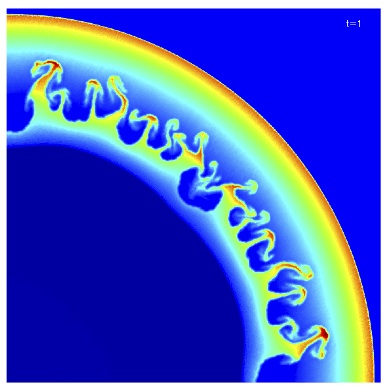
Paper title: Smoothed Particle Hydrodynamics: Things I wish my mother taught me Author: D. J. Price Author’s Affiliation: Monash Centre for Astrophysics (MoCA), School of Mathematical Sciences, Monash University, Vic 3800, AustraliaThe title of this article caught my eye on the arXiv for two reasons: rarely do authors mention their mother in a paper, and like the author I also wished that my mother (or anyone) had taught me about smoothed particle hydrodynamics. The author soon clarifies that actually it was his PhD supervisor, not his mother, who he wishes had taught him the important details related to simulations, so in fact the rest of the paper pays no further attention to family ties. But, the subject of smoothed particle hydrodynamics (SPH) still fascinates me, and seems to be extremely relevant to current astronomy, so I will summarize the topic here. I should also make the disclaimer that I have never used SPH, so what I present is merely what I have learned from reading the paper.Fundamentals: SPH is a computational method used to model flows, and it is used in a variety of subjects including astrophysics and oceanography. It begins with a known distribution of point-mass particles, and computes density such that density is independent of the following particle characteristics: (1) the absolute positions of the particles, (2) arbitrary rotations, and (3) histories of the particles. Summing up the density comprises what the author calls the fundamental axiom of SPH, as it use discrete particles of fixed mass to describe fluid properties. The resolution of the method (or the smallest step-size that one can take) depends on the...
by Courtney Dressing | Nov 10, 2011 | Daily Paper Summaries
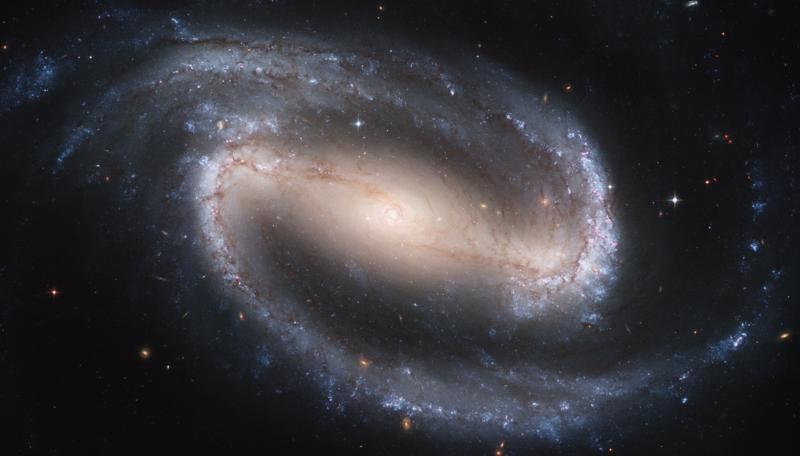
Paper title: Bars rejuvenating bulges? Evidence from stellar population analysis Authors: Paula Coelho and Dimitri A. Gadotti First author’s affiliation:Núcleo de Astrofísica Teórica, Universidade Cruzeiro do Sul, São Paulo, Brasil SummaryAs you may recall from Nathan Sanders’ April post, some spiral galaxies have central bulges with high concentrations of stars. Coelho and Gadotti examine a sample of 575 of these galaxies to investigate whether the presence or absence of a bar (a bar-shaped overdensity of stars) influences the rate of star formation in the central bulge. Astronomers expect to see a higher star formation rate in the bulges of barred galaxies because bars can transport gas from the outer regions of the galaxy into the center and supply fuel for growing stars. Previous detections of star-formation indicators (such as enhanced Hα emission) have indicated that the current star formation rates are higher in barred spirals than in unbarred spirals, but Coelho and Gadotti take the alternative approach of determining the ages of the stellar populations in the bulges. They find that the bulges of barred galaxies are systematically younger than the bulges of unbarred galaxies, which is consistent with the expectation that bars should promote star formation. The Galaxy SampleIn a previous paper, Gadotti derived stellar masses, bulge stellar masses, bar properties, and other parameters for a sample of face-on galaxies observed by Sloan Digital Sky Survey (SDSS). All of the galaxies had stellar masses above 10^10 solar masses and redshifts between 0.02 and 0.07. Selecting face-on galaxies reduced the effect of dust and simplified the process of identifying bars and bulges in the galaxies. In this paper, Coelho...
