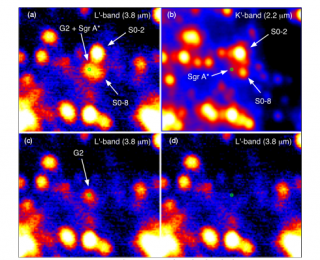
The Hidden Heart of G2
A central object in the gas cloud G2, near the galactic centre

A central object in the gas cloud G2, near the galactic centre
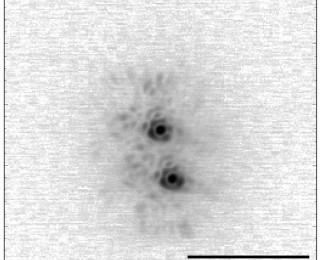
For several years now, there has been considerable interest in circumbinary planets – that is to say, planets that orbit both stars in a binary system. They pose many interesting questions, such as, “How does their formation differ from planets in single-star systems?”, “What will happen to them when the stars evolve?”, and of course, “Could humans live there?” It was because of questions like these that the authors of today’s paper turned their telescopes on KIC 7177553.
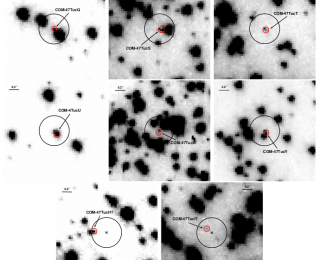
Images from the Hubble Space Telescope show that there are previously unknown white dwarfs orbiting around pulsar companions.
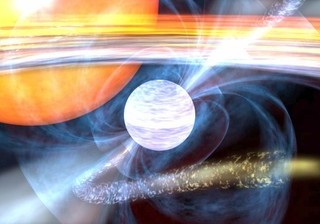
Pulsars, or rapidly-spinning neutron stars, have been observed to suddenly change in spin. Typically, the pulsars we’ve seen do this are isolated—what happens if they have a stellar companion?
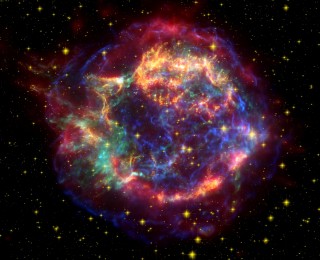
A supernova goes off. A star has died. Can its partner have anything to do with it?
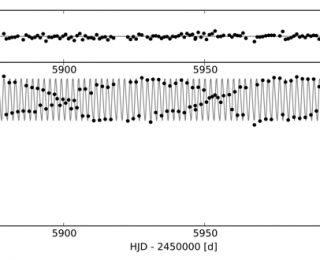
Cepheids’ pulsing brightness variations happen because the star’s temperature and radius is changing, and they occupy a unique niche of stellar evolution. We can learn a lot about what is physically happening inside stars during this tumultuous time through close observations. Or rather, we could learn a lot about what happens inside Cepheid variable stars, if only we knew their masses.