• RSS
  • Submit a Guest Post
  • Undergraduates: Submit your Research!
  • Suggest a Paper Topic!
astrobites
  • About
    • About Astrobites
    • Meet the Authors
    • Statement of Inclusivity
    • Copyright & Permissions
  • Latest Research
    • Daily Paper Summaries
    • Classics
    • Undergrad Research
    • Physical Review Coverage
  • Beyond astro-ph
    • Beyond astro-ph Library
    • Interviews
    • Career Navigation
    • Personal Experiences
    • Current Events
    • Teaching with Astrobites
  • Guides
    • EM Spectrum
    • Galaxies & AGNs
    • Spectroscopy and Spectral Lines
    • Adaptive Optics
    • Gravitational Waves
    • Transient Astronomy
    • Astrophysical Software
    • Graduate School
    • Writing a personal statement for grad apps
    • First Observing Run
    • …More Guides!
Select Page
Highlighting AAS Chambliss Contestants

Highlighting AAS Chambliss Contestants

by Ashley Villar | Jun 20, 2016 | Current Events, Undergraduate Research

The latest science from a few early-career researchers.

The merger of two castaways

The merger of two castaways

by Michael Küffmeier | May 16, 2016 | Daily Paper Summaries

Recently, several supernovae have been observed that do not fit in any of the known categories. These Calcium-rich supernovae are challenging to explain, but in this astrobite you read that they are likely the result of an expelled merger.
The Formation of Wide Binaries

The Formation of Wide Binaries

by Stacy Kim | Apr 26, 2016 | Daily Paper Summaries

Most stars—including Polaris, Sirius, and those in Orion’s Belt—actually hide multiple stars. Some of these stars are on orbits so wide that they may no longer be gravitationally bound. Why?
Globular clusters as gravitational wave factories

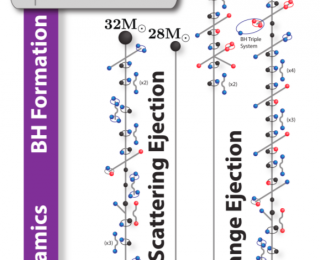
Globular clusters as gravitational wave factories

by Anson Lam | Apr 22, 2016 | Daily Paper Summaries

The dense environments in the center of globular clusters lead to an abundance of binary black hole mergers, potentially detectable by LIGO.
Brilliant Binaries: Explaining Reionisation

Brilliant Binaries: Explaining Reionisation

by Christopher Lovell | Apr 20, 2016 | Daily Paper Summaries

Could binary stars help explain one of the big unsolved problems in the early universe?
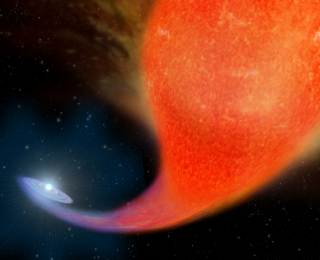
Pursuing eternal youth: stellar cannibalism in the wilds of our galaxy

Pursuing eternal youth: stellar cannibalism in the wilds of our galaxy

by Leonardo dos Santos | Apr 12, 2016 | Daily Paper Summaries

Recent surveys of the sky showed the presence of stars that seem to be too young for the population that they belong to. In today’s bite, we will see that cannibalism between two very close stars could be a viable way to produce these curious objects.

« Older Entries
Next Entries »

Loading

Follow our socials

  • Bluesky
  • Facebook
  • Instagram
  • RSS Feed

More Posts About

AAS AGN astronomy astrophysics binary stars black holes cosmology dark matter dwarf galaxies exoplanets galaxies galaxy evolution gravitational waves habitability JWST Kepler Milky Way observations planetary science planet formation protoplanetary disks radio astronomy simulations solar system spectroscopy star formation stars stellar evolution supernovae theory

Posts by Category

  • Accessibility
  • Applications
  • Beyond
  • Book Reviews
  • Career Navigation
  • Classics
  • Climate Change
  • Course Assignments
  • Crossposts
  • Current Events
  • Daily Paper Summaries
  • Game Reviews
  • Guides
  • Historical Astronomy
  • Instrumentation
  • Interviews
  • Outreach
  • Personal Experiences
  • PRJ
  • Quick Notes
  • Satellites
  • Teaching
  • Undergraduate Research

More Astronomy

  • AAS
  • AAS Nova
  • astro-ph
  • AstroBetter
  • APOD

Read Astrobites in Other Languages

  • Astrobitos (Spanish)
  • Astropontos (Portuguese)
  • staryab (Farsi)

Listen to Astrobites

  • astro[sound]bites

Discover More Incredible Science

  • ScienceBites Network
  • RSS

© 2026 Astrobites | All Rights Reserved | Supported by AAS | Designed by Elegant Themes | Powered by WordPress