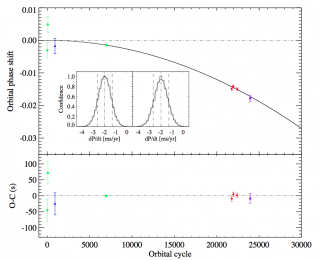
Orbital Decay of X-ray Binaries
In today’s paper, the authors study how the periods of two black hole x-ray binaries are changing. They find that the periods are decaying faster than expected based on standard theoretical arguments.

In today’s paper, the authors study how the periods of two black hole x-ray binaries are changing. They find that the periods are decaying faster than expected based on standard theoretical arguments.
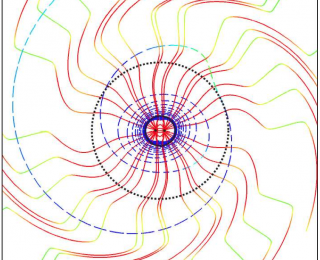
Field lines are a powerful tool for building intuition for a complex geometric object.
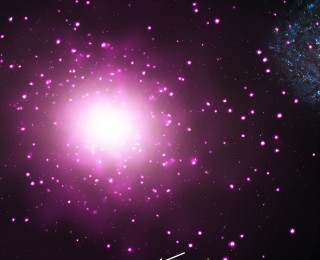
The densest galaxy in the local Universe may have been found. M60-UCD1 is most likely a tidally-stripped remnant of a more massive progenitor galaxy. Strader et al. predicts that the progenitor of M60-UCD1 was ~ 50-200 times more massive, suggesting that it was once an elliptical galaxy that has been stripped of most of its mass.

NASA is looking for a new mission for the damaged Kepler space telescope. Here are some ideas.

Sgr A* – the supermassive black hole sitting in the center of the Milky Way – is often referred to as a ‘starved’ black hole, meaning that it swallows very little of the nearby cosmic gas and dust. The authors of this paper observed Sgr A* with the Chandra X-ray telescope for 3 mega seconds, throughout which only 1% of the gas available to Sgr A* actually accreted onto the black hole. It swallows cold gas, while rejecting hot gas – ejecting the matter back into space.
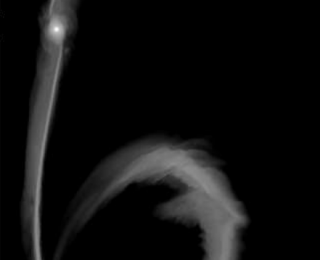
The authors of today’s paper investigate the feeding habits of the elusive quiescent supermassive black hole, finding that in addition to swallowing some stars whole and constantly snacking on the winds of other stars, some black holes may also dine on giant stars slowly disrupted over tens to hundreds of orbits.