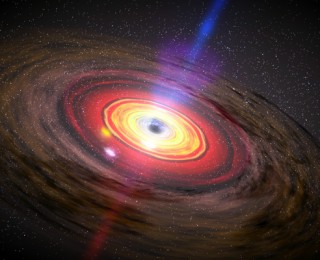
Tracking the Accretion Flow Geometry Around Black Holes
By looking at the spectral changes of the accretion disk emission around black holes, we can trace the physical changes of the accreting material.

By looking at the spectral changes of the accretion disk emission around black holes, we can trace the physical changes of the accreting material.
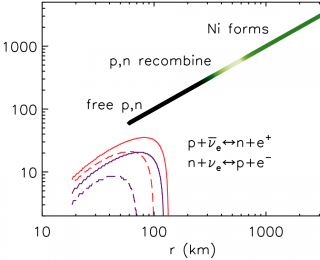
There aren’t many places in the universe that you can find a bunch of free neutrons not already trapped inside a nucleus—except in neutron stars. Luckily, neutron stars in violent mergers with other neutron stars, or with black holes, tend to disperse a little bit of their matter into the interstellar medium. Tidal forces eject some matter as the two objects swing around each other in their final orbits. Then, if an accretion disk forms, winds blown off the surface of the disk disperse even more matter. Surman and her colleagues look at the nucleosynthesis that occurs in this latter process, and find something surprising.
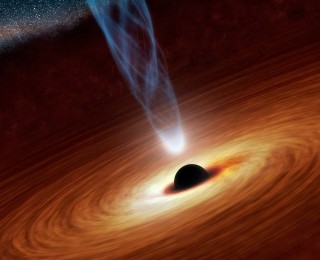
Stephen Hawking proposes that black holes may not have definite event horizons, meaning they’re really more like “gray” holes.
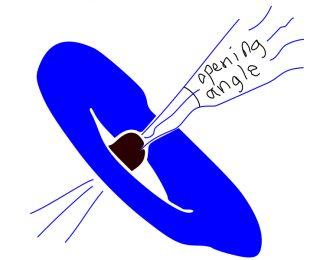
Null data are still data! Chen & Holz use a lack of detections to place a lower limit on the beaming angle of SGRBs.
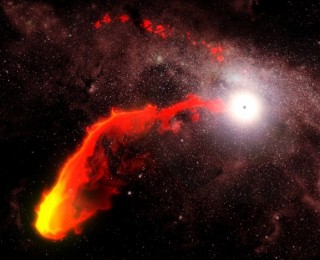
The black hole at the center of our galaxy, Sgr A*, is a very picky eater. However, with the discovery of the G2 cloud, astronomers have had the opportunity to watch the infrequent feeding process in Sgr A* in action. While the origin of this cloud is still debated, research is beginning to suggest that G2 is a gas cloud that was ripped away from a giant star in orbit around our galaxy’s central black hole.
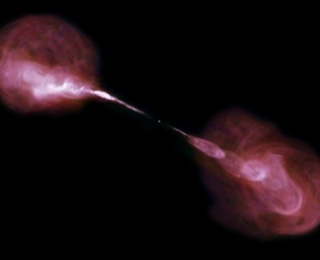
Has a multi-wavelength study of AGN across a large redshift range revealed that these energetic giants do not impact upon their host galaxy as significantly as previously thought?