by Suk Sien Tie | May 22, 2015 | Daily Paper Summaries
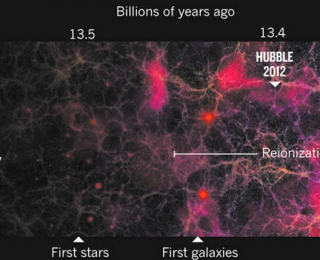
Cosmic reionization is a period in the Universe history when it switched from being predominantly neutral to mostly ionized. We still haven’t quite pinned down the source(s) that caused this transition, but we have our suspicions. It could be quasars. It could be galaxies. Or could it be something else?
[Figure from universe-review.ca/F05-galaxy06.htm]
by Becky Smethurst | Feb 26, 2015 | Daily Paper Summaries
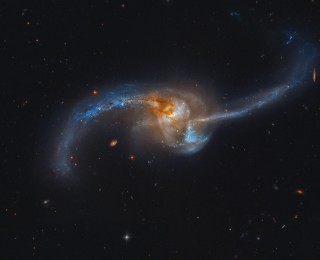
By measuring the black hole mass and velocity dispersion of currently merging galaxies each in various stages of a merger, the authors conclude that the growth of the central super massive black hole occurs in the early stages of each merger and outpaces any bursts of star formation or central bulge growth.
by Suk Sien Tie | Feb 12, 2015 | Daily Paper Summaries
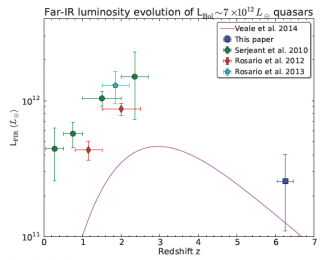
Black holes are found in most galaxies. Observations suggest that they correlate with various properties of their host galaxies. Does this correlation hold in the very early Universe, particularly in galaxies hosting supermassive black holes? The answer is ….
by Brett Deaton | Nov 4, 2014 | Daily Paper Summaries
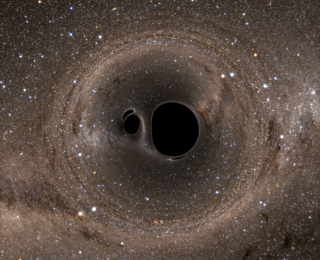
What kind of lens is a BBH merger? These authors present the first pictures of light sources lensed by numerical models of BBH mergers.
by Becky Smethurst | Oct 2, 2014 | Daily Paper Summaries
Direct observational evidence for positive feedback from the interaction of outbursts from active black holes and the surrounding medium has been lacking so far, until now…
by Josh Fuchs | Apr 15, 2014 | Daily Paper Summaries
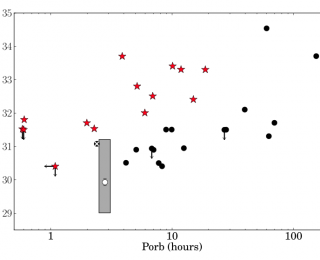
The authors report the discovery of perhaps the faintest black hole x-ray binary. But this conclusion is limited by the uncertainty in the distance to the object.
