by Adele Plunkett | Dec 9, 2011 | Daily Paper Summaries
Paper title: Verifying the no-hair property of massive compact objects with intermediate-mass-ratio inspirals in advanced gravitational-wave detectors Authors: Carl L. Rodriguez, Ilya Mandel, Jonathan R. Gair First Author’s Affiliation: Center for Interdisciplinary Exploration and Research in Astrophysics (CIERA) & Dept. of Physics and Astronomy, Northwestern UniversityThese authors propose that advanced gravitational wave detectors will be able to directly detect the coalescence of compact objects, such as neutron stars (NS) and black holes (BH). The gravitational waves resulting when a neutron star or stellar-mass black hole inspirals into an intermediate-mass black hole give interesting information about gravitational physics (go here to watch cool videos of BHs colliding). The goal is to directly test general relativity (a review paper is found here).A significant advance in this field comes from the next generation of detectors and experiments. Two such observatories are Advanced LIGO (Laser Interferometer Gravitational-wave Observatory, a project with two interferometers in Washington and one in Louisiana) and Virgo (near Pisa, Italy). Advanced LIGO should achieve sufficient sensitivity by 2015 to detect compact binaries as they interact and coalesce. This paper specifically develops the technique to detect high-mass systems with a total mass in the range of 25 to 100 solar masses, where one component is greater than one solar mass and the other less than 99 solar masses. The systems in this study are called Intermediate-mass-ratio inspirals (IMRIs) because the mass ratios between the two objects (the more massive object at the center and the object spiraling inward) are between 10:1 and 100:1.Do objects like this really exist? Observational and theoretical models suggest the presence of intermediate-mass black holes (IMBHs)...
by Dan Gifford | Nov 29, 2011 | Daily Paper Summaries
Using a clever technique, the authors identify a sub-population of rotating Wolf-Rayet stars.
by Kim Phifer | Oct 23, 2011 | Daily Paper Summaries
Astronomers study light, but as it turns out, not all objects that we are interested in are observable in any part of the electromagnetic spectrum. In cases such as these, we have to turn to indirect detection methods.
by Ian Czekala | Oct 20, 2011 | Daily Paper Summaries
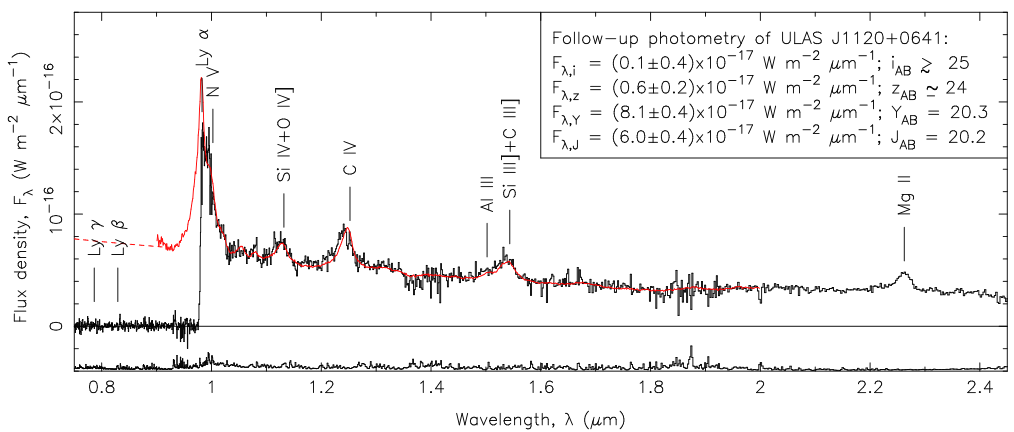
While high-redshift quasars are very interesting objects in their own right, their incredible luminosities allow them to act as background light sources that illuminate the intervening universe on our line of sight. One could think of quasars as giant flashlights that the universe uses to make really interesting spectroscopic shadow puppets back here on Earth.
by Guest | Oct 17, 2011 | Daily Paper Summaries
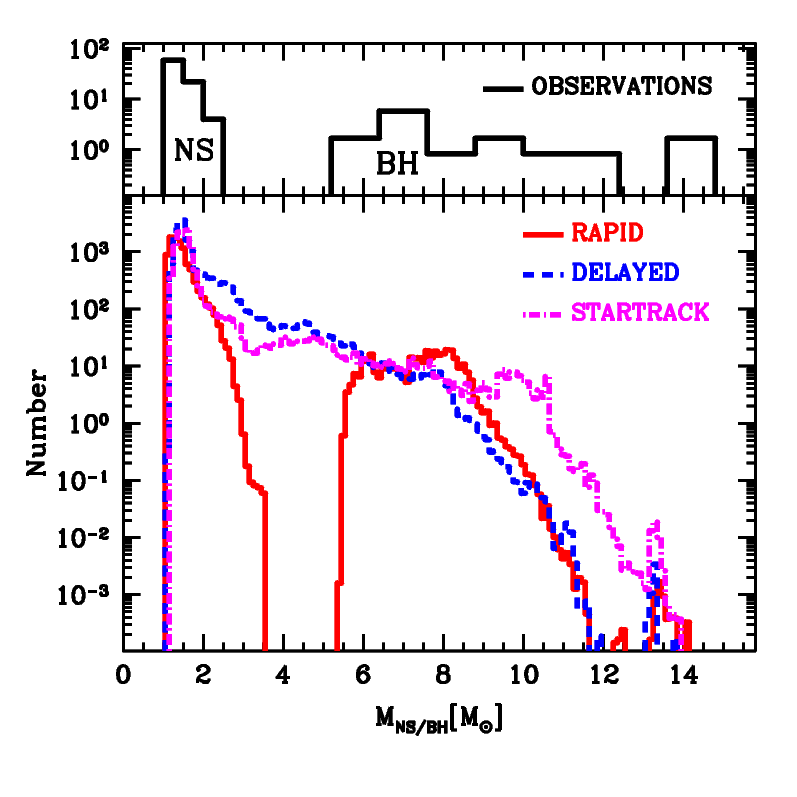
You might think that stars with an approximately continuous distribution of masses would lead to remnants with an approximately continuous distribution masses. But you’d be wrong.
by Maria Drout | Sep 23, 2011 | Daily Paper Summaries
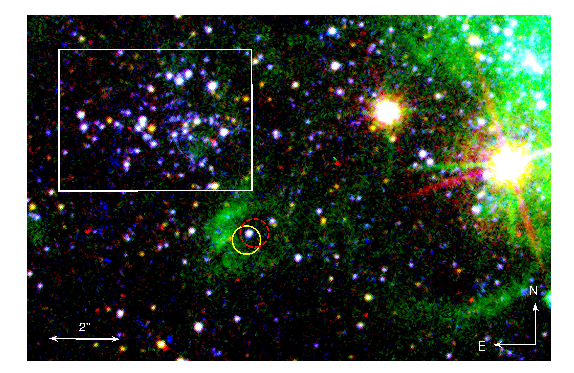
Continuums seem to be the name of the game in astronomy. On more than one occasion, astronomers have defined discrete subclasses for a type of phenomena only to later discover objects which populate an intermediate space between their original classifications. So… what about black holes?
