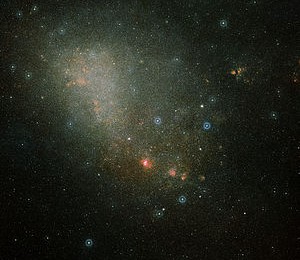
Interstellar Lithium in the Small Magellanic Cloud
What can a nearby dwarf galaxy tell us about the the chemical evolution of the universe?

What can a nearby dwarf galaxy tell us about the the chemical evolution of the universe?
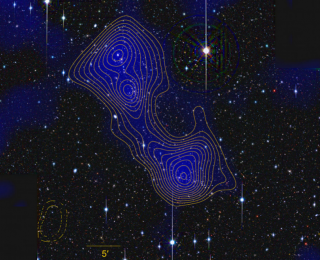
Throughout much of the 20th century, it was an open question in astronomy as to what the universe looked like on the largest observable scales. Were galaxies and galaxy clusters distributed uniformly throughout space, or was there a pattern? Thanks to galaxy surveys we know that, on large scales, the matter distribution of the universe is clumpy instead of smooth. Through these surveys we observe directly the distribution of luminous matter like stars, gas, and galaxies. However, luminous matter comprises only a small fraction of the matter in the universe (17%), the rest is dark matter which interacts via gravity but does not absorb and emit electromagnetic radiation like normal matter. Theoretical simulations of dark matter cosmologies firmly predict that there is a dark matter backbone to the cosmic web, with filaments of dark matter stretching between clusters of galaxies, though has not yet been a robust detection of a dark matter filament, until now.
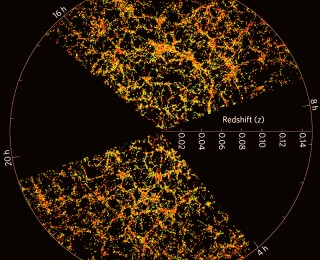
Two upcoming space telescope missions, WFIRST and Euclid, will be able to shed light on the nature of the mysterious dark energy.
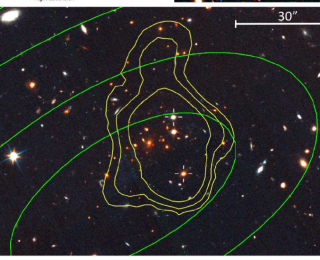
The authors discover a strong lensing arc behind an unusually massive galaxy cluster at high redshift. The existence of such a lensing system at high redshift is found to be inconsistent with the standard cosmological model.
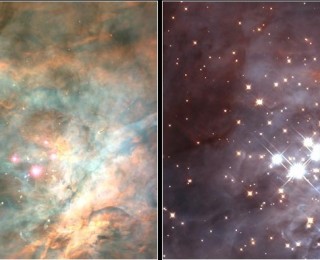
This paper demonstrates a brand new method of calculating Hubble’s Constant using the luminosity of HII galaxies.
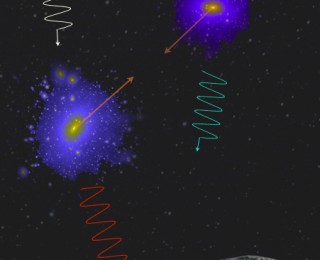
Astronomers present the first-ever detection of the motion of distant galaxy clusters via an effect first theorized 40 years ago.