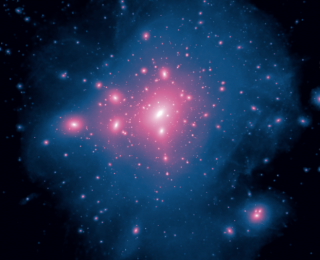
Disentangling Dark Matter Physics
We can’t study dark matter directly by our usual means of studying the cosmos: light. But dark matter leaves its fingerprints on the universe in other ways…

We can’t study dark matter directly by our usual means of studying the cosmos: light. But dark matter leaves its fingerprints on the universe in other ways…

In a special particlebites cross-post, we cover the latest results in the search for a direct detection of dark matter from the LHC.
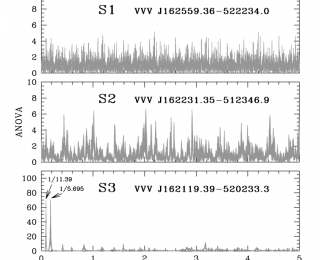
Today we use a new paper to revisit the possible dwarf galaxy discovered 90 kpc from the Milky Way.
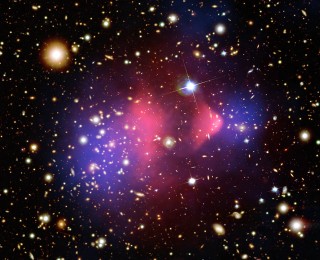
The dark matter halos of galaxies and clusters of galaxies—objects of literally astronomical dimensions—have lots to say about the mysterious, likely subatomic, dark matter particle.
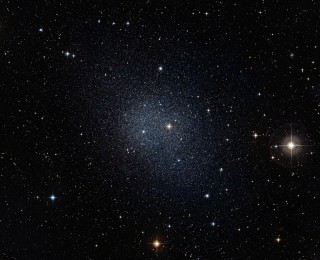
Dark matter dominated dwarf spheroidal galaxies are some of the best places to test predictions on how dark matter behaves in the Universe. Predictions for how the dark matter should be distributed in these galaxies disagrees with what is actually observed, however. The authors of today’s Astrobite investigate how the dark matter profiles may evolve over time from what is predicted to what we see today.
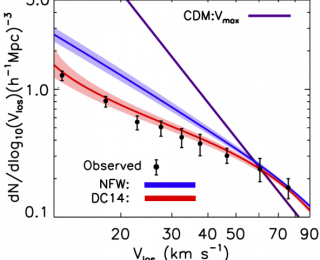
Dark matter permeates the Universe and surrounds every galaxies in the form of dark matter halos. We don’t really know dark matter works, as predictions of standard cosmology, Lambda Cold Dark Matter (ΛCDM), are way off from observations. Is this the death of Cold Dark Matter, or there are something more to it?