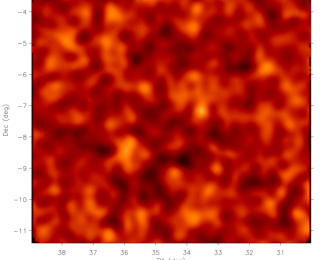
by Elisa Chisari | Dec 11, 2013 | Daily Paper Summaries
Gravitational lensing is the deflection of the trajectory of a photon by gravity, and it is a natural consequence of the theory of General Relativity. Lensing distorts the shapes and orientations of galaxies and in today’s post, we discuss a new method to reconstruct dark matter maps of our Universe using the position angles of galaxies.
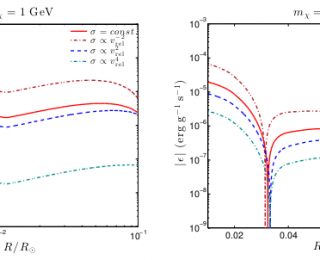
by Anson Lam | Nov 25, 2013 | Daily Paper Summaries
Depending on how they scatter with nuclei, dark matter particles might affect the structure and evolution of our Sun.
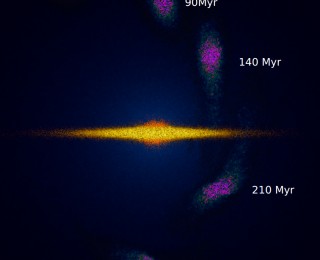
by Ryan Foltz | Oct 11, 2013 | Daily Paper Summaries
Using the upcoming Gaia telescope to measure ripples in the Milky Way will allow us to detect the impact of clumps of dark matter on our host galaxy.
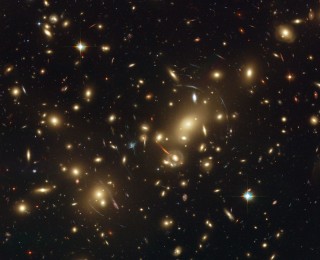
by Chris Faesi | Oct 9, 2013 | Daily Paper Summaries
New results from stacked weak lensing measurements of over a hundred thousand galaxies show that, on large scales, light from stars appears to trace the dark matter distribution of the Universe remarkably well.

by Kirit Karkare | Jun 24, 2013 | Daily Paper Summaries
Dark matter particles annihilating could potentially create electrons and positrons, generating continuum synchrotron emission. This paper attempts to find this signature in nearby dwarf galaxies.
by Jessica Donaldson | May 15, 2013 | Daily Paper Summaries
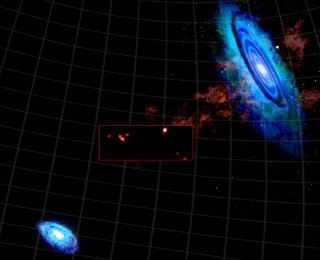
Seven gas clouds have been found in the region between two galaxies. Are they part of a intergalactic filament or remnants from a past galaxy interaction?
