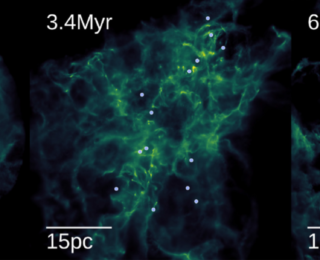
by Michael Foley | Nov 8, 2019 | Daily Paper Summaries
Observations of Giant Molecular Clouds (GMCs) yield large scatters in star formation efficiencies. Simulations in this work show that much of this scatter may stem from the fact we observe GMCs at different evolutionary stages driven by stellar feedback.
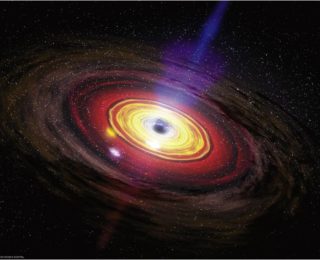
by Ellis Avallone | Oct 7, 2019 | Daily Paper Summaries
We all know planets form around stars, can planet formation occur around something much more exotic?
by Jenny Calahan | Mar 1, 2019 | Daily Paper Summaries
Today’s post has been inspired by the following quote: “have yall seen this new theory of how the moon formed?? …honestly im shook”
by Mia de los Reyes | Jan 5, 2019 | Career Navigation, Current Events
Some galaxies are easy to find—others, like dusty galaxies with extreme star formation, are a bit harder to track down. Come to Professor Caitlin Casey’s #AAS233 talk to learn how we can find these galaxies in the “obscured early universe”!
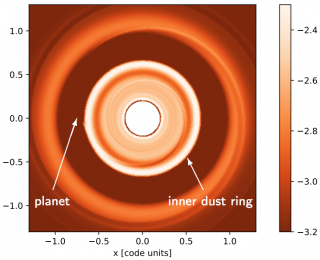
by Michael Hammer | Nov 15, 2018 | Daily Paper Summaries
It is difficult to tell if planets embedded in their natal protoplanetary disks are migrating closer to their stars. The authors of today’s paper devise a new observational signature to figure that out.
by Jamila Pegues | Sep 4, 2018 | Daily Paper Summaries
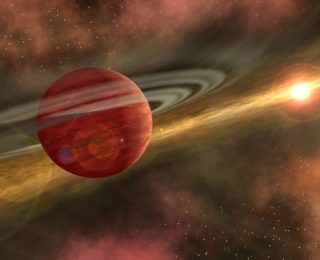
According to one theory of planet formation, the secret to forming massive planets is through itsy-bitsy, teeny-weeny pebbles of dust. In today’s astrobite, we explore what sort of planets these little pebbles could form.
