• RSS
  • Submit a Guest Post
  • Undergraduates: Submit your Research!
  • Suggest a Paper Topic!
astrobites
  • About
    • About Astrobites
    • Meet the Authors
    • Statement of Inclusivity
    • Copyright & Permissions
  • Latest Research
    • Daily Paper Summaries
    • Classics
    • Undergrad Research
    • Physical Review Coverage
  • Beyond astro-ph
    • Beyond astro-ph Library
    • Interviews
    • Career Navigation
    • Personal Experiences
    • Current Events
    • Teaching with Astrobites
  • Guides
    • EM Spectrum
    • Galaxies & AGNs
    • Spectroscopy and Spectral Lines
    • Adaptive Optics
    • Gravitational Waves
    • Transient Astronomy
    • Astrophysical Software
    • Graduate School
    • Writing a personal statement for grad apps
    • First Observing Run
    • …More Guides!
Select Page
Dancing in the Dark

Dancing in the Dark

by Mia de los Reyes | Apr 16, 2018 | Daily Paper Summaries

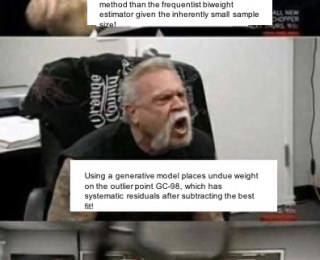
Confused by the hubbub about the “galaxy lacking dark matter”? Fear no more! In today’s Astrobite, we’ll examine some hot takes by the scientific community.
The Imprint of Cosmic Reionization on Dwarf Galaxies

The Imprint of Cosmic Reionization on Dwarf Galaxies

by Nora Shipp | Mar 29, 2018 | Daily Paper Summaries

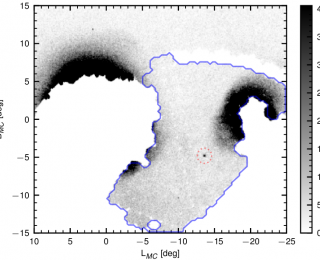
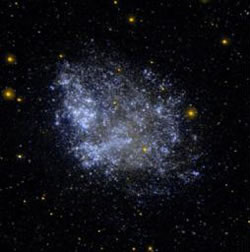
What can the smallest galaxies in the local Universe tell us about reionization?
A Little Less in the Dark

A Little Less in the Dark

by Tarini Konchady | Mar 28, 2018 | Daily Paper Summaries

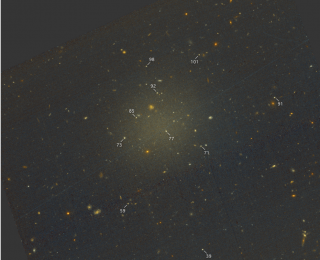
A dwarf galaxy in Cetus appears to have a serious lack of dark matter.
For Whom the Cosmic Web Tolls

For Whom the Cosmic Web Tolls

by Mia de los Reyes | Mar 6, 2018 | Daily Paper Summaries

“No [galaxy] is an island entire of itself; every [galaxy] / is a piece of the [cosmic web], a part of the main” – apologies to John Donne for butchering his poem.
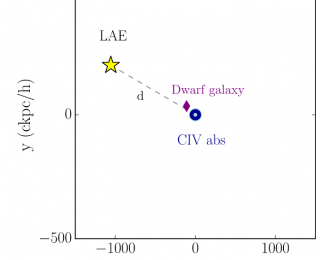
Ghostly Hosts: Looking for the Sources of Enrichment

Ghostly Hosts: Looking for the Sources of Enrichment

by Caitlin Doughty | Feb 9, 2018 | Daily Paper Summaries

What created the strong CIV absorption near this Lyman Alpha Emitter?

Where do globular clusters (maybe) come from?

Where do globular clusters (maybe) come from?

by Mia de los Reyes | Dec 15, 2017 | Daily Paper Summaries

Today’s paper suggests that globular clusters might come from a newly-discovered class of low-mass galaxies called “Little Blue Dots.” And even if you don’t care about globular clusters, you should read this post anyway to learn about some weird names for different types of galaxies.

« Older Entries
Next Entries »

Loading

Follow our socials

  • Bluesky
  • Facebook
  • Instagram
  • RSS Feed

More Posts About

AAS AGN astronomy astrophysics binary stars black holes cosmology dark matter dwarf galaxies exoplanets galaxies galaxy evolution gravitational waves habitability JWST Kepler Milky Way observations planetary science planet formation protoplanetary disks radio astronomy simulations solar system spectroscopy star formation stars stellar evolution supernovae theory

Posts by Category

  • Accessibility
  • Applications
  • Beyond
  • Book Reviews
  • Career Navigation
  • Classics
  • Climate Change
  • Course Assignments
  • Crossposts
  • Current Events
  • Daily Paper Summaries
  • Game Reviews
  • Guides
  • Historical Astronomy
  • Instrumentation
  • Interviews
  • Outreach
  • Personal Experiences
  • PRJ
  • Quick Notes
  • Satellites
  • Teaching
  • Undergraduate Research

More Astronomy

  • AAS
  • AAS Nova
  • astro-ph
  • AstroBetter
  • APOD

Read Astrobites in Other Languages

  • Astrobitos (Spanish)
  • Astropontos (Portuguese)
  • staryab (Farsi)

Listen to Astrobites

  • astro[sound]bites

Discover More Incredible Science

  • ScienceBites Network
  • RSS

© 2026 Astrobites | All Rights Reserved | Supported by AAS | Designed by Elegant Themes | Powered by WordPress