by Suk Sien Tie | Jul 17, 2015 | Daily Paper Summaries
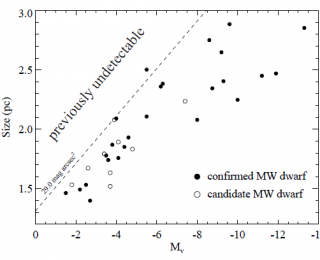
Dwarf galaxies are getting the limelight nowadays due to their high dark matter content. However, current search method only picks up bright dwarfs in certain region of the sky, potentially missing a large number of faint dwarfs in other parts of the sky. Maybe we should start searching in a different way?
by Andrew Emerick | Apr 21, 2015 | Daily Paper Summaries
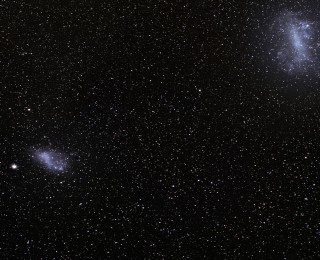
There is quite a lot left to learn about the smallest galaxies in our Universe, dwarf galaxies. Since they are small compared to galaxies like the Milky Way, they are challenging to observe directly, either because they are too dim or because they are too small to be resolved. The authors suggest a new detection method for these faint galaxies that takes advantage of ongoing and upcoming large surveys looking for, among other things, novae and supernovae.
by Stacy Kim | Apr 17, 2015 | Daily Paper Summaries
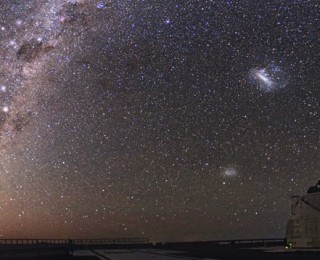
The Milky Way grew by accreting many smaller galaxies. What did these doomed galaxies leave behind, and what could they say about the Milky Way’s early past?
by Ben Cook | Mar 18, 2015 | Daily Paper Summaries
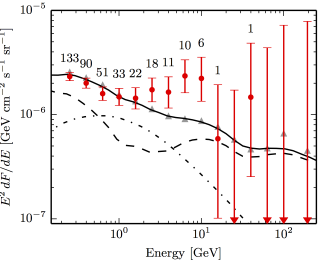
If dark matter particles can collide to release gamma-rays, the best place to see them will be in the centers of dwarf galaxies. Archival Fermi-LAT images around Reticulum 2 show the first ever detection of gamma-rays from a dwarf galaxy. Dark matter detection may be close at hand!
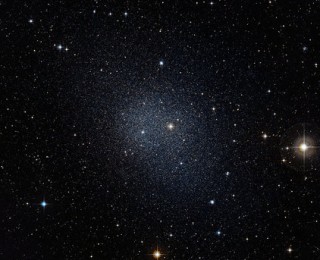
by Stacy Kim | Jan 16, 2015 | Daily Paper Summaries
Dwarf galaxies have long been vaunted a useful probe for dark matter physics due to their high dark matter content. But is this true for all dwarfs, particularly the smallest ones? And can the minority baryons affect dark matter signatures?
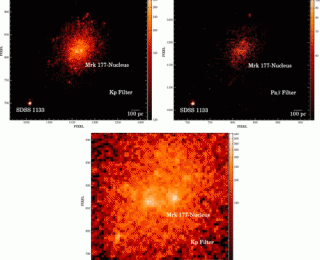
by David Wilson | Dec 15, 2014 | Daily Paper Summaries
The space between galaxies, long thought to be a near empty void, is now rapidly being revealed to be home to a host of astronomical phenomena. Now astronomers may have added a new type of intergalactic resident to the list: a super-massive black hole, a million times the mass of the Sun, kicked out from its home galaxy.
