• RSS
  • Submit a Guest Post
  • Undergraduates: Submit your Research!
  • Suggest a Paper Topic!
astrobites
  • About
    • About Astrobites
    • Meet the Authors
    • Statement of Inclusivity
    • Copyright & Permissions
  • Latest Research
    • Daily Paper Summaries
    • Classics
    • Undergrad Research
    • Physical Review Coverage
  • Beyond astro-ph
    • Beyond astro-ph Library
    • Interviews
    • Career Navigation
    • Personal Experiences
    • Current Events
    • Teaching with Astrobites
  • Guides
    • EM Spectrum
    • Galaxies & AGNs
    • Spectroscopy and Spectral Lines
    • Adaptive Optics
    • Gravitational Waves
    • Transient Astronomy
    • Astrophysical Software
    • Graduate School
    • Writing a personal statement for grad apps
    • First Observing Run
    • …More Guides!
Select Page
How do you see a firefly next to a spotlight?

How do you see a firefly next to a spotlight?

by David Gooding | Jun 21, 2021 | Daily Paper Summaries

A look at some clever observing techniques to directly image exoplanets.

How deep is an exoplanet’s ocean?

How deep is an exoplanet’s ocean?

by Zili Shen | Jun 12, 2021 | Daily Paper Summaries

Astronomers model oceans outside of our Solar system and explore exotic planets.
Astrobites at AAS 238: Day 3

Astrobites at AAS 238: Day 3

by Astrobites | Jun 10, 2021 | Current Events

We report on Day 3 of the virtual summer AAS meeting.
UR: Characterizing the atmosphere of hot Jupiter CoRoT-1 b

UR: Characterizing the atmosphere of hot Jupiter CoRoT-1 b

by Guest | May 30, 2021 | Undergraduate Research

In our latest #UndergradResearch post, we learn how Kayli Glidic used eclipse spectra to characterize the atmosphere of a hot Jupiter.
What happens to planets when their host star dies?

What happens to planets when their host star dies?

by Macy Huston | May 22, 2021 | Daily Paper Summaries

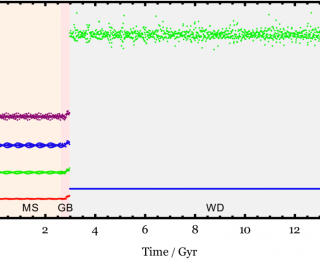
What happens to planets when their host star dies? Today’s authors explore how HR 8799 could become a metal-polluted white dwarf in an unusual planetary system.
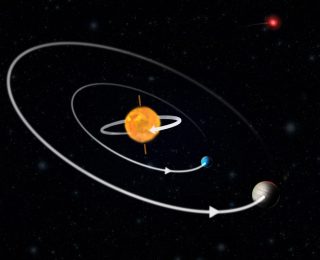
A Star Askew: A Potential Cause of the Misalignment of a Star and Its Planets

A Star Askew: A Potential Cause of the Misalignment of a Star and Its Planets

by Ali Crisp | Apr 13, 2021 | Daily Paper Summaries

When the rotation of a star is misaligned from the orbits of its planets, astronomers often attribute the misalignment to planetary dynamics. In the case of K2-290 A, today’s authors instead attribute its misalignment to its stellar companion.

« Older Entries
Next Entries »

Loading

Follow our socials

  • Bluesky
  • Facebook
  • Instagram
  • RSS Feed

More Posts About

AAS AGN astronomy astrophysics binary stars black holes cosmology dark matter dwarf galaxies exoplanets galaxies galaxy evolution gravitational waves habitability JWST Kepler Milky Way observations planetary science planet formation protoplanetary disks radio astronomy simulations solar system spectroscopy star formation stars stellar evolution supernovae theory

Posts by Category

  • Accessibility
  • Applications
  • Beyond
  • Book Reviews
  • Career Navigation
  • Classics
  • Climate Change
  • Course Assignments
  • Crossposts
  • Current Events
  • Daily Paper Summaries
  • Game Reviews
  • Guides
  • Historical Astronomy
  • Instrumentation
  • Interviews
  • Outreach
  • Personal Experiences
  • PRJ
  • Quick Notes
  • Satellites
  • Teaching
  • Undergraduate Research

More Astronomy

  • AAS
  • AAS Nova
  • astro-ph
  • AstroBetter
  • APOD

Read Astrobites in Other Languages

  • Astrobitos (Spanish)
  • Astropontos (Portuguese)
  • staryab (Farsi)

Listen to Astrobites

  • astro[sound]bites

Discover More Incredible Science

  • ScienceBites Network
  • RSS

© 2026 Astrobites | All Rights Reserved | Supported by AAS | Designed by Elegant Themes | Powered by WordPress