by Munira Hoosain | Apr 15, 2026 | Daily Paper Summaries
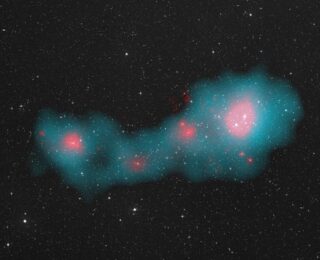
The Shapley Supercluster is widely recognised as the most massive gravitationally bound structure in the local universe.The supercluster is made up of 11 galaxy clusters and groups and extends across ~ 260 megaparsecs. At its core, which this paper focuses on, are five clusters. This core hosts several radio haloes,which are caused by shock-heated gas from the Intracluster medium (ICM) and is evidence of ongoing cluster merger activity. This supercluster core is highly dynamically active (full of cluster-cluster mergers), which could influence the evolution of galaxies within the core. This paper examines the evolution of galaxies by observing the cold gas within galaxies (i.e. the neutral hydrogen) and compares several galaxy properties to do so (see also: this previous Astrobite featuring ram-pressure stripped galaxies in the Shapley Supercluster).
by Madison VanWyngarden | Apr 14, 2026 | Daily Paper Summaries
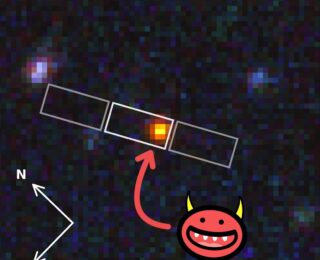
Today’s bite reports the discovery of the most distant red galaxy ever confirmed!
by Niloofar Sharei | Apr 7, 2026 | Daily Paper Summaries
What if JWST’s early massive galaxies are not overestimated, but underestimated? A bottom-heavy IMF could hide tons of mass in faint stars.
![[Guest] The Walking Red: Why are you so quiet and overdense?](https://astrobites.org/wp-content/uploads/2026/02/cover-1-320x260.png)
by Guest | Apr 3, 2026 | Daily Paper Summaries
Why do we see so many massive, dead galaxies at early cosmic times? Guest author Tatevik Mkrtchyan illuminates a slice of the cosmic graveyard!
by Nicki Bond | Mar 30, 2026 | Accessibility, Daily Paper Summaries
In today’s paper, we explore how blazar light curves can be transformed into music and the benefits of this for both scientists and science communication.

by Guest | Mar 19, 2026 | Daily Paper Summaries
What do a galaxy’s stellar clumps tell us about how it formed? Today’s guest author Michelle Park explores interesting properties of clumps from the FIRE simulations.
