
by Guest | Mar 18, 2026 | Daily Paper Summaries
Clumpy galaxies dominate the early universe, yet their local counterparts are hard to find. A new machine‑learning approach learns to spot these hidden clumps and opens the door to studying them in far greater detail.
by Madison VanWyngarden | Mar 10, 2026 | Daily Paper Summaries
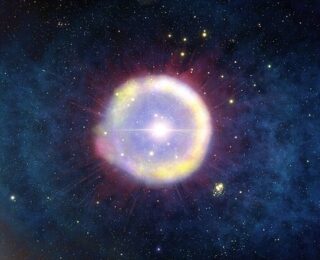
Today’s bite explores a new method to find the galaxies hosting the Universe’s first generation of stars
by Munira Hoosain | Mar 6, 2026 | Daily Paper Summaries
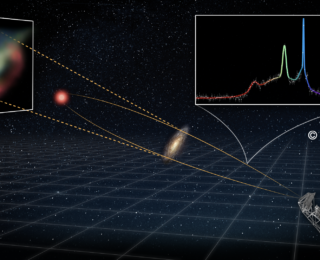
Space is full of unusual and (sometimes) quite powerful phenomena that cause light to behave in unexpected ways. Maser systems are one of these phenomena. The MeerKAT Radio Telescope recently detected the most luminous and distant hydroxyl (or OH) maser system – so intense it crossed the threshold from “mega-maser” to “giga-maser”. Discover why this system is so remarkable in this bite!

by Jayde Willingham | Mar 5, 2026 | Daily Paper Summaries
So we have a pretty good idea of how old the Universe is right? Well according to JWST data, maybe not? Rest assured, today’s bite gets to the bottom of the debate.
by Nicki Bond | Mar 4, 2026 | Daily Paper Summaries
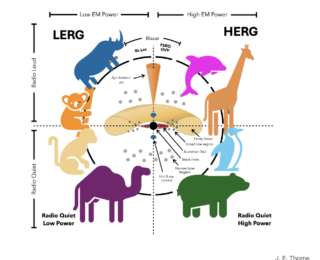
How do the eating habits (accretion) of active galactic nuclei (AGN) affect the light emitted for animals in the AGN zoo?
by Serat Saad | Mar 2, 2026 | Daily Paper Summaries
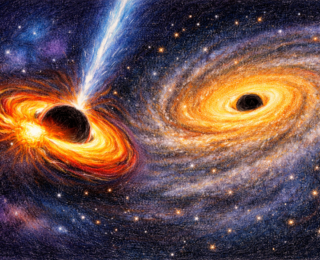
For the first time, a supermassive black hole is discovered away from its galaxy’s center, exposed when it tears apart a star in a tidal disruption event.
