by Nick Hand | Oct 29, 2013 | Daily Paper Summaries
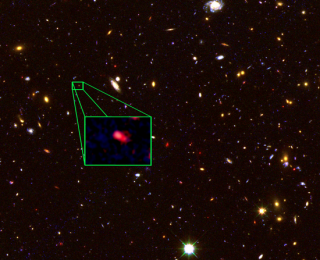
The authors of this work report the discovery of the most distant, spectroscopically-confirmed galaxy found to date, which presently lies about 30 billion light years from Earth. The galaxy is being observed as it was at a time just 700 million years after the Big Bang, which is a mere 5% of the universe’s current age of 13.8 billion years.
by Shannon Hall | Oct 4, 2013 | Daily Paper Summaries
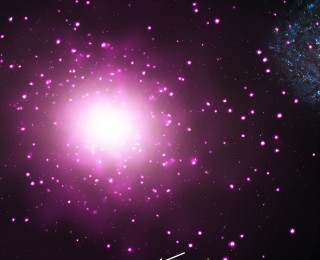
The densest galaxy in the local Universe may have been found. M60-UCD1 is most likely a tidally-stripped remnant of a more massive progenitor galaxy. Strader et al. predicts that the progenitor of M60-UCD1 was ~ 50-200 times more massive, suggesting that it was once an elliptical galaxy that has been stripped of most of its mass.
by Betsy Mills | Aug 10, 2013 | Daily Paper Summaries
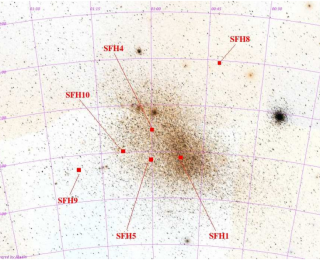
The authors of today’s paper find out just what kind of star formation history lies in the Milky Way’s next meal: The Small Magellanic Cloud. After all, they say you are what you eat.
by Ryan Foltz | Jul 21, 2013 | Daily Paper Summaries
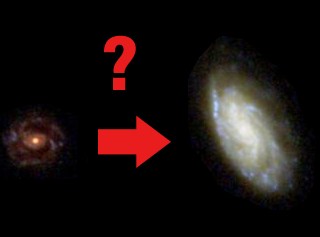
Galaxies have more than doubled in size since they first formed, but why?
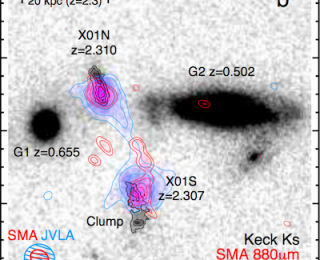
by Allison Strom | Jun 8, 2013 | Daily Paper Summaries
A team of researchers present multiwavelength observations of a rare merger between two massive, gas-rich starburst galaxies at a redshift of 2.3. This kind of merger could help explain the presence of the most massive elliptical galaxies at high redshift.
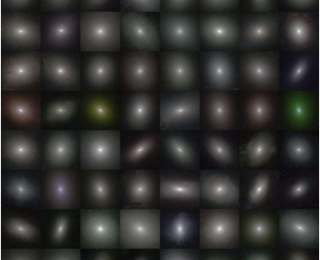
by Alice Olmstead | Apr 14, 2013 | Daily Paper Summaries
Huang et al. dig up evidence that distant “red nugget” galaxies grew into the massive ellipticals we see today by consuming smaller, gas-poor galaxies.
