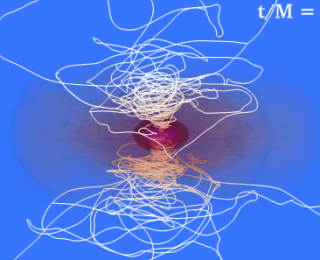
Neutron Star Mergers May Help Short GRBs Go “Boom”
Short gamma ray bursts are one of the biggest cosmic mysteries of modern astronomy. Today’s post investigates one possible culprit for this phenomena – the merging of two neutron stars.

Short gamma ray bursts are one of the biggest cosmic mysteries of modern astronomy. Today’s post investigates one possible culprit for this phenomena – the merging of two neutron stars.
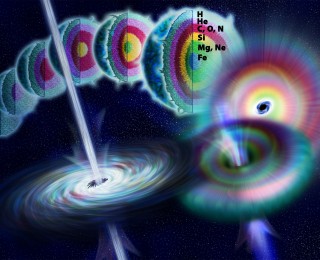
Astronomers have known for a while that GRBs are sign-posts to galaxies which are forming lots of stars. But today’s paper used radio observations of the gas to connect that star formation to a recent merger.
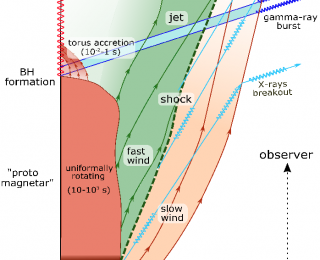
In today’s paper, Rezzolla and Kumar present a solution to the x-ray afterglow problem for the short gamma ray burst model. They show that x-rays can glow steadily for hours after the initial gamma ray emission due to the interactions of a slow and a fast wind.
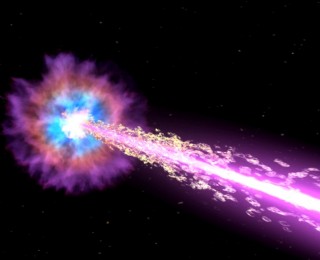
Asteroids and volcanoes are familiar harbingers of global doom. But what about Gamma Ray Bursts? Is another doomsday lurking?
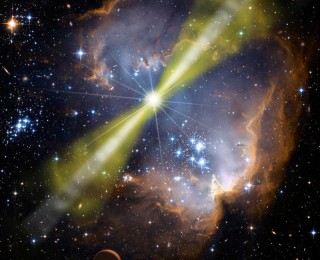
Some GRB-SNe pairs show interesting correlations across their light curves.
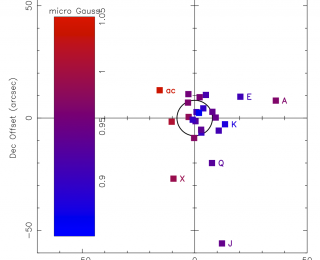
This month’s undergraduate research post features pulsars as a probe of our galaxy’s magnetic field, and the possibility of asymmetries in supernovae associated with gamma-ray bursts.