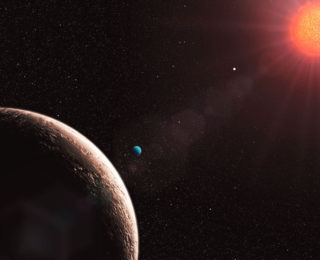
U(V) Light Up My Life
We know that too much UV radiation is bad for humans, but could it actually be necessary for life?

We know that too much UV radiation is bad for humans, but could it actually be necessary for life?
A combination of infrared spectrograph and laser frequency comb provides unprecedented precisions in the hunt for habitable planets around nearby, cool stars.
We report on Day 3 of the winter AAS meeting in Seattle, WA. Highlights include updates in X-ray astronomy, the discovery of a second repeating FRB, an exploration of astrochemistry in planet-forming disks, and a look at the 2020 Astronomy Decadal Survey.

For tightly packed exoplanet systems, tidal force from other planets may be a significant factor to consider.
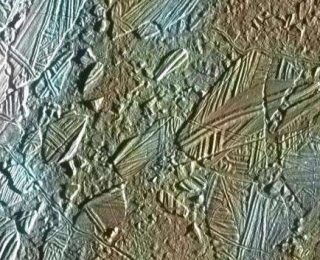
Let’s take a trip back to 1979 to check out the first signs of an ocean hidden deep beneath Europa’s icy shell.

Most of the known exoplanets resemble “hot Jupiters” because they’re bigger and easier to find. But how can we find Earth-like planets? Check out Dr. Debra Fischer’s plenary talk at #AAS232 to learn more about the “Past, Present, and Future” of exoplanet science.