by Suk Sien Tie | Feb 12, 2015 | Daily Paper Summaries
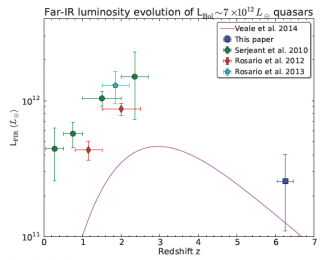
Black holes are found in most galaxies. Observations suggest that they correlate with various properties of their host galaxies. Does this correlation hold in the very early Universe, particularly in galaxies hosting supermassive black holes? The answer is ….
by Astrobites | Aug 23, 2014 | Undergraduate Research
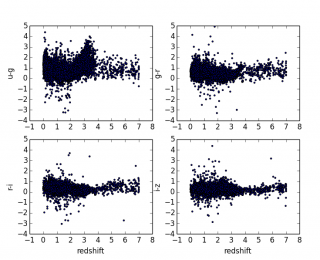
How can the colors of objects tell you how far away they are? The subject of this month’s undergrad research post tells us about his work determining the colors of quasars.
by Anson Lam | Dec 23, 2013 | Daily Paper Summaries
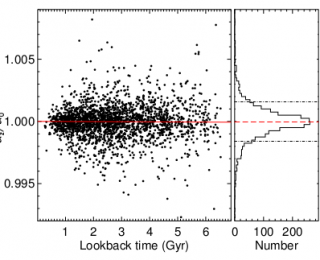
From measurements of quasar spectra, we can determine whether or not the fine structure constant is really a constant.
by Guest | Jul 14, 2013 | Classics, Daily Paper Summaries
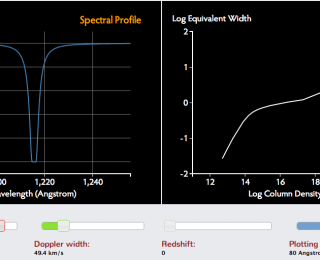
This guest post, the first in a three-part series, reviews the classic article by Gunn & Peterson (1965). This paper proposed several fundamental ideas in cosmology, including using distant quasars as “flashlights” to observe the diffuse gas between galaxies.
by Elisa Chisari | Feb 2, 2013 | Daily Paper Summaries
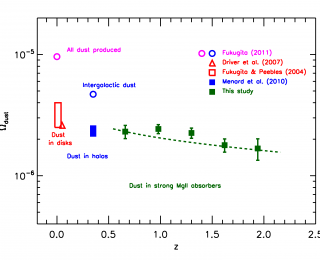
Dust is really ubiquitous in the Universe: it is everywhere from our Solar System to stars and the interstellar medium. However, the observations of dust in galaxies fall short of the prediction of how much dust there is in the Universe. In this work, the authors try to alleviate this problem by estimating the amount of dust present in clouds of gas that inhabit galaxy halos while they look for clues regarding the origin of these clouds.
by Allison Strom | Apr 19, 2012 | Daily Paper Summaries
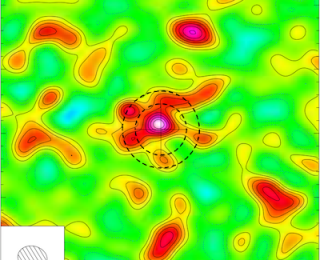
The idea of “negative feedback” on star formation in galaxies is ubiquitous, but the debate about what causes the massive outflows we see in galaxies is far from over. Now, Maiolino et al. have found evidence of a massive quasar-driven outflow at z > 6, making it the earliest instance yet of a central black hole affecting its host galaxy on a global scale.
