by Elizabeth Lovegrove | Feb 13, 2012 | Daily Paper Summaries
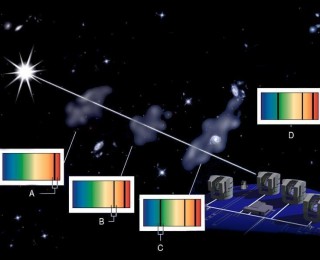
When the light from a distant quasar finally arrives at Earth, it often carries far more information than it did when it was emitted – the shadows of gas and galaxies that have intervened over the cosmic distances between us and the source. These features can tell us how the universe evolves in both space and time, by allowing us to sample both low and high redshifts for structures that would not otherwise be visible. This paper uses a new IR spectrograph, FIRE, deployed on the Magellan 6.5 m telescopes, to present the first high-redshift sample of Mg II absorption systems, including the most distant Mg II system yet found (z = 5.33). The authors show that the number of strong Mg II systems appears to peak and decline in number along with the star formation history of the universe, suggesting a correlation between the two, while weak Mg II systems stay mysteriously constant.
by Kirit Karkare | Jan 31, 2012 | Daily Paper Summaries
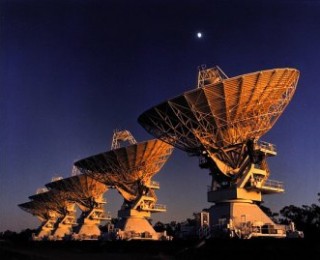
Using a rotational transition of methanol, this paper attempts to see if a fundamental constant has changed over cosmic time.
by Ian Czekala | Oct 20, 2011 | Daily Paper Summaries
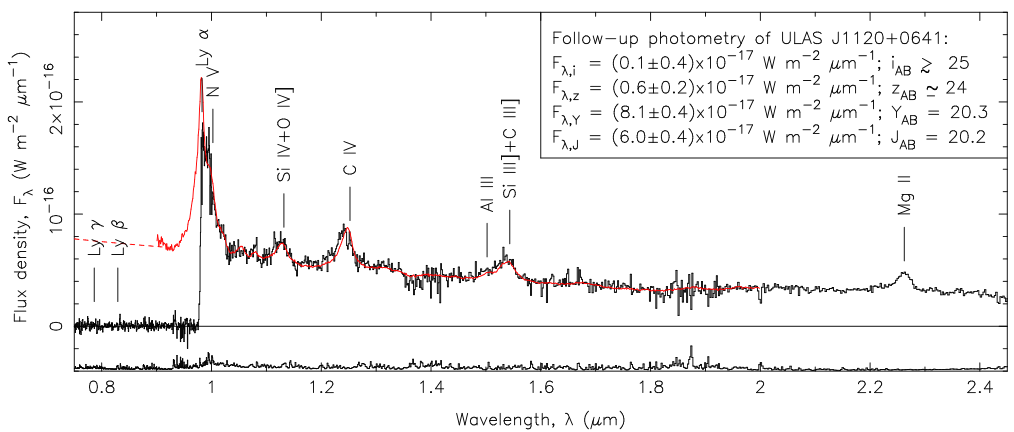
While high-redshift quasars are very interesting objects in their own right, their incredible luminosities allow them to act as background light sources that illuminate the intervening universe on our line of sight. One could think of quasars as giant flashlights that the universe uses to make really interesting spectroscopic shadow puppets back here on Earth.
by Courtney Dressing | Sep 30, 2011 | Daily Paper Summaries
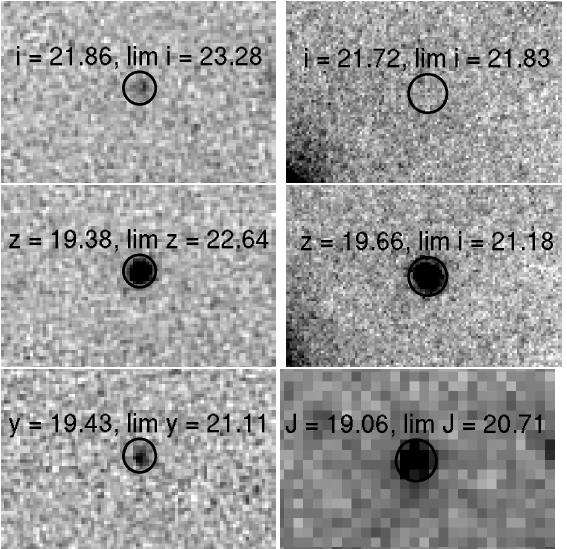
Morganson et al. announce the discovery of the first quasar discovered by Pan-STARRS. The newly detected quasar is a Broad Absorption Line quasar at a redshift of 5.73 +/- 0.02 with a z band magnitude of 19.4, a luminosity of 3.8×1047 erg/s, and an estimated black hole mass of 6.9×10⁹ solar masses.
by Nathan Sanders | Aug 8, 2011 | Daily Paper Summaries
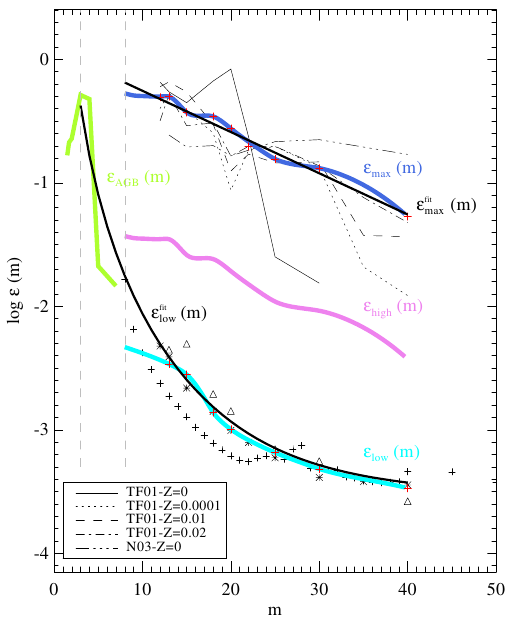
I just vacuumed my apartment and asked the question, ‘how does so much dust accumulate in one week?’ These authors ask a more scientifically interesting question: how can galaxies accumulate more than 100 million solar masses of dust in just a few hundred million years?
by Nathan Goldbaum | Jul 17, 2011 | Daily Paper Summaries
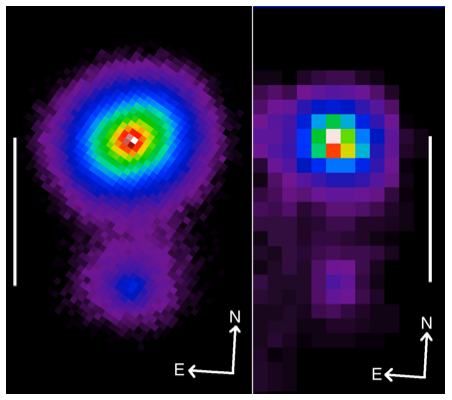
While there are many examples of AGN pairs with relatively large separations, there are (including the object discussed in this paper) currently only six known closely separated pairs. Unless there are many more undiscovered closely separated AGN pairs, something must be seriously wrong with our theoretical understanding of galaxy mergers and black hole growth.
