• RSS
  • Submit a Guest Post
  • Undergraduates: Submit your Research!
  • Suggest a Paper Topic!
astrobites
  • About
    • About Astrobites
    • Meet the Authors
    • Statement of Inclusivity
    • Copyright & Permissions
  • Latest Research
    • Daily Paper Summaries
    • Classics
    • Undergrad Research
    • Physical Review Coverage
  • Beyond astro-ph
    • Beyond astro-ph Library
    • Interviews
    • Career Navigation
    • Personal Experiences
    • Current Events
    • Teaching with Astrobites
  • Guides
    • EM Spectrum
    • Galaxies & AGNs
    • Spectroscopy and Spectral Lines
    • Adaptive Optics
    • Gravitational Waves
    • Transient Astronomy
    • Astrophysical Software
    • Graduate School
    • Writing a personal statement for grad apps
    • First Observing Run
    • …More Guides!
Select Page
Radio Images of a Nearby, Ghostly Globule

Radio Images of a Nearby, Ghostly Globule

by Thankful Cromartie | Oct 31, 2017 | Daily Paper Summaries

A ghostly plasma lens occulting QSR J1819+3845 has been imaged directly at radio wavelengths. What can we learn about this strange interloper? (Image: unrelated observation of solar activity resembling a jack-o’-lantern, courtesy NASA/GSFC/SDO)
Lensed Substructures

Lensed Substructures

by Stacy Kim | Jan 27, 2017 | Daily Paper Summaries

Many dark galaxies may be hiding unseen in the universe—but we still might be able to detect them. Here’s how.
Supermassive Black Holes Tango in a Distant Quasar

Supermassive Black Holes Tango in a Distant Quasar

by Maria Charisi | Jan 26, 2017 | Daily Paper Summaries

Supermassive black holes are among the most exciting objects in the universe. Even more so, when they dance around each other after the merger of two galaxies.
Radio Crickets: A New Probe of General Relativity

Radio Crickets: A New Probe of General Relativity

by Michael Zevin | Jul 29, 2015 | Daily Paper Summaries

Today’s astrobite is not about disc jockey insects informing us about spacetime. Read on to find out a novel way of detecting electromagnetic counterparts of merging supermassive black holes.
“Your heart sounds just fine, PSO J334.2028+01.4075”

“Your heart sounds just fine, PSO J334.2028+01.4075”

by Brett Deaton | Apr 22, 2015 | Daily Paper Summaries

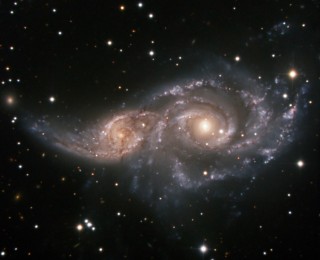
Quasar PSO J334.2028+01.4075 has a very healthy heart rate of 6.7 beats per decade, or once every 542 days. One explanation is that this guy hosts a pair of supermassive black holes. If true, then the astonishing interpretation of this quasar’s heart rate is that its black holes are only a few orbits away from merging!
Protogalaxy Collisions Birthing Supermassive Black Holes

Protogalaxy Collisions Birthing Supermassive Black Holes

by Suk Sien Tie | Apr 9, 2015 | Daily Paper Summaries

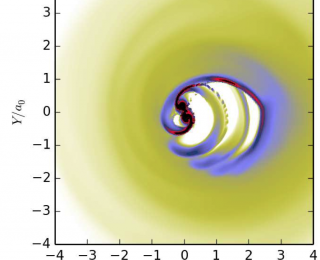
How are supermassive black holes created in the first place? Oh, we need supermassive stars of course! But then, how do we form these supermassive stars…? The answer could be by ramming two protogalaxies against one another at high speeds.

« Older Entries
Next Entries »

Loading

Follow our socials

  • Bluesky
  • Facebook
  • Instagram
  • RSS Feed

More Posts About

AAS AGN astronomy astrophysics binary stars black holes cosmology dark matter dwarf galaxies exoplanets galaxies galaxy evolution gravitational waves habitability JWST Kepler Milky Way observations planetary science planet formation protoplanetary disks radio astronomy simulations solar system spectroscopy star formation stars stellar evolution supernovae theory

Posts by Category

  • Accessibility
  • Applications
  • Beyond
  • Book Reviews
  • Career Navigation
  • Classics
  • Climate Change
  • Course Assignments
  • Crossposts
  • Current Events
  • Daily Paper Summaries
  • Game Reviews
  • Guides
  • Historical Astronomy
  • Instrumentation
  • Interviews
  • Outreach
  • Personal Experiences
  • PRJ
  • Quick Notes
  • Satellites
  • Teaching
  • Undergraduate Research

More Astronomy

  • AAS
  • AAS Nova
  • astro-ph
  • AstroBetter
  • APOD

Read Astrobites in Other Languages

  • Astrobitos (Spanish)
  • Astropontos (Portuguese)
  • staryab (Farsi)

Listen to Astrobites

  • astro[sound]bites

Discover More Incredible Science

  • ScienceBites Network
  • RSS

© 2026 Astrobites | All Rights Reserved | Supported by AAS | Designed by Elegant Themes | Powered by WordPress