by Tim Lichtenberg | Apr 28, 2015 | Daily Paper Summaries
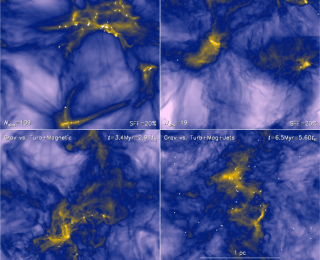
Stars form via gravitational collapse of molecular cloud cores. But observations reveal that far less gas is turned into stars than you would suspect by naively calculating the star formation rate. So what can we do about this mismatch?
by Gudmundur Stefansson | Apr 20, 2015 | Classics, Daily Paper Summaries
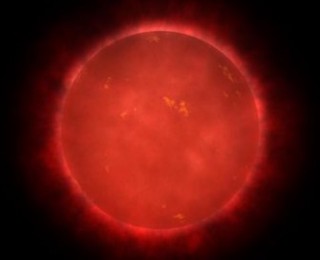
Heavy stars live like rock stars: they live fast, become big, and die young. Low mass stars, on the other hand, are more persistent, and live longer. Fusing hydrogen slow and steady wins the stellar age-race.

by Michael Küffmeier | Apr 3, 2015 | Classics, Daily Paper Summaries
Planets seem to occur all over the place in the universe. However, it is still unknown how they form. The growth of objects larger than meter size is difficult because objects of this size quickly fall into the central star. This Astrobite gives a small overview of the meter-size barrier as found by Stuart J. Weidenschilling in 1977.
by Michael Küffmeier | Mar 31, 2015 | Daily Paper Summaries
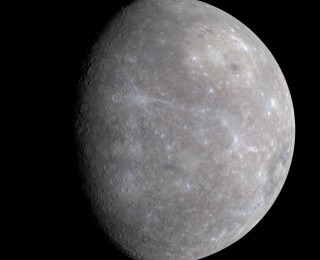
Mercury is the smallest planet in the Solar System, but some of its properties are a big challenge to explain. Today’s Astrobite presents a solution to one of these issues: The darkening of Mercury is induced by a high abundance of carbon delivered by meteorites.
by Caroline Huang | Mar 24, 2015 | Daily Paper Summaries
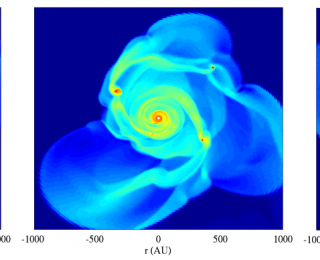
The first stars may have formed in clusters, rather than in isolation as previously thought. What would these clusters look like?
by Stacy Kim | Mar 12, 2015 | Daily Paper Summaries
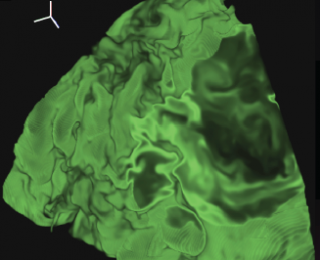
New 3D simulations that capture the last minutes of a massive star’s life reveal that its violently turbulent interior can affect how it dies.
