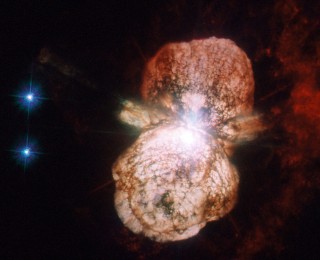
by Michael Zevin | Mar 11, 2015 | Daily Paper Summaries
The massive binary star system Eta Carinae has been examined like never before in a recent study. Read on to hear the new discoveries from this approach, and the potential it opens for astrophysical research.

by Tim Lichtenberg | Mar 6, 2015 | Daily Paper Summaries
Earth’s oceans may have originated mainly from accreted impactors. But do planets in other systems experience the same water delivery mechanism? Or do they even get more water than our world? Find out why you would want to think about this and what the consequences might be.
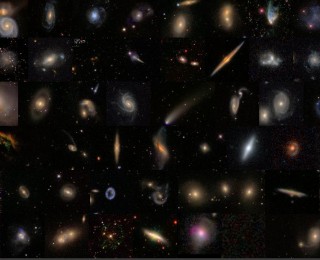
by Ben Cook | Feb 20, 2015 | Daily Paper Summaries
This paper reports the results of a cosmological simulation, and how smooth accretion and mergers affect three important aspects of galaxy formation: stellar mass growth, size increase, and morphology changes.
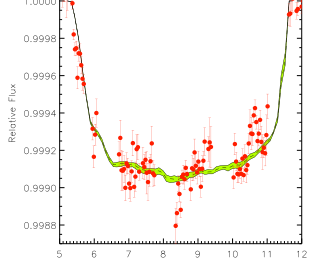
by Michael Küffmeier | Feb 3, 2015 | Daily Paper Summaries
Most exoplanets are and have been detected by the transit method. Maybe, we can improve the method even further by drawing conclusions from the recent Venus transits in 2004 and 2012.
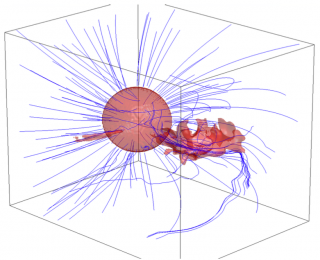
by Meredith Rawls | Jan 22, 2015 | Daily Paper Summaries
In today’s paper, Čechura and Hadrava examine what happens to the runaway gas from the surface of massive stars—the stellar wind. In particular, they look at systems with massive stars so close to a companion neutron star or black hole that the stellar wind is jarred into a new orbit and heated to the point of emitting X-rays.

by Michael Küffmeier | Jan 13, 2015 | Daily Paper Summaries
Magnetic fields are a crucial part of star formation. Read on whether and how the magnetic field strength dissipates during the early collapsing phase.
