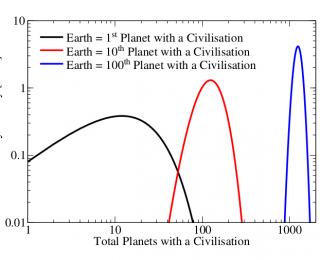
Estimating the number of intelligent civilizations from planet formation rates
By combining galaxy formation histories and planet formation models, we can estimate the number of potential civilizations in our Universe.

By combining galaxy formation histories and planet formation models, we can estimate the number of potential civilizations in our Universe.
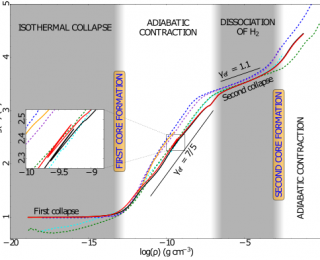
The process of star formation is exciting. During the early phases, a protostar undergoes two characteristic collapses. Today’s Astrobite explains the two collapse phases and briefly discusses their effects on the “final” product: the second core.
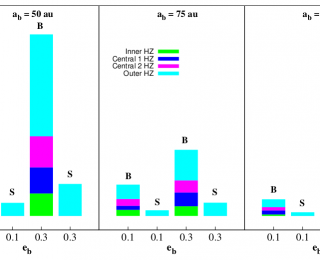
Planets in binary star systems can receive a sizable amount of water from asteroids getting perturbed out of their orbits
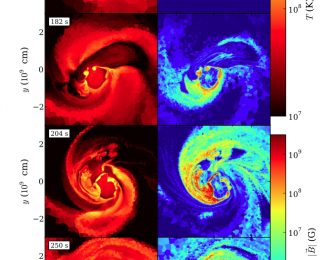
White dwarfs in a binary often merge into a variety of interesting phenomena. However, nobody has sought to understand the role that magnetic fields play during the merger. The authors simulate the merging of two white dwarfs with magnetic fields to see what happens.
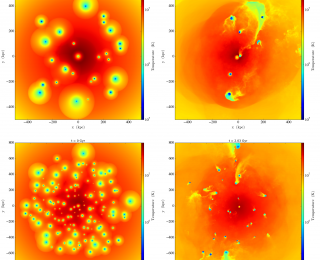
The evolution of a galaxy is strongly dependent upon the environment the galaxy lives in. Galaxies moving through galaxy groups and galaxy clusters can get stripped of their gas that would otherwise be used to form stars. Today’s astrobite discusses simulations of the stripping and removal of the hot, gaseous coronae that surround galaxies.
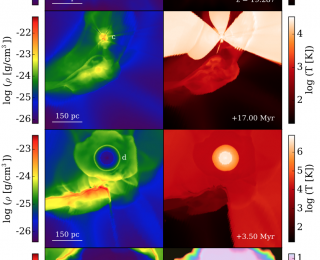
Stars formed in the early Universe were extremely massive and extremely low in elements heavier than helium. The transition from the first to the second generation of stars is still hidden in the shadows of the past. However, simulations of the most massive supernovae can help us to decipher the way of how the life cycle of stars came into being.