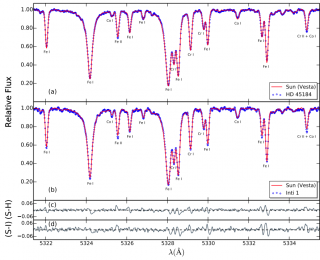
Accidentally Finding a Solar Twin
After accidentally observing the wrong star this paper’s authors discovered a previously-unknown solar twin, a type of star which can help shed light on a number of questions in astronomy.

After accidentally observing the wrong star this paper’s authors discovered a previously-unknown solar twin, a type of star which can help shed light on a number of questions in astronomy.
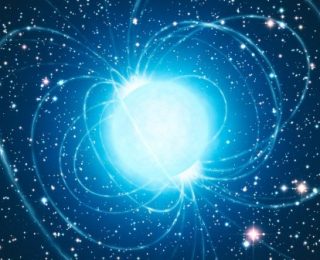
Magnetic fields always make things more compiclated. In today’s paper, the authors studied their effect on the atmosphere of white dwarf stars.
Image credits: ESO/L. Calçada
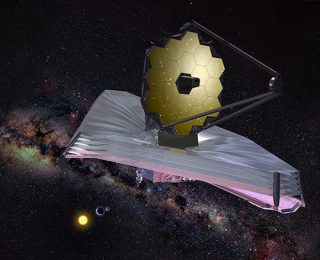
With the imminent launch of the James Webb Space Telescope next year, many scientists are asking what is next? Today’s bite, which focuses on a recent workshop on global coordination: future space-based Ultraviolet-Optical-Infrared Telescopes, hopefully represents the first steps towards the next big space telescope.
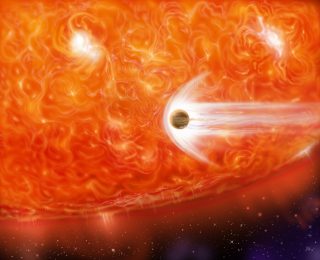
Two attempts to measure the masses of retired A-type stars give two different results.
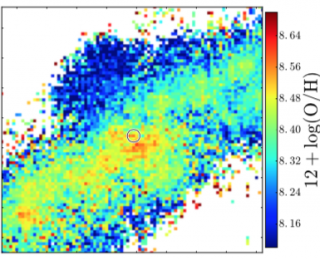
A long-duration GRB was detected without its expected supernova companion. Today’s astrobite chronicles one team’s efforts to try and uncover the cause of GRB 111005A’s loneliness.
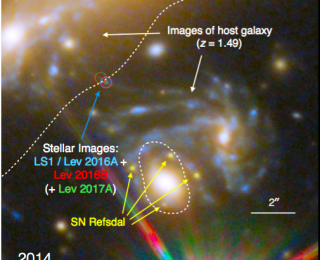
So far, Gravitational Lensing has allowed us to observe distant faint galaxies or supernovae. Its time to observe individual stars now.