
Title: No evidence for excess AGN activity in recently quenched massive galaxies at cosmic noon
Authors: Omar Almaini, Vivienne Wild, David Maltby, Elizabeth Taylor, Kate Rowlands, Thomas de Lisle, Katherine Alatalo, Jimi Harrold, Guillaume Hewitt, Pallavi Patil, Maya Skarbinski
First Author’s Institution: School of Physics and Astronomy, University of Nottingham, University Park, Nottingham NG7 2RD, UK
Status: Published in Monthly Notices of the Royal Astronomical Society [open access]
Background
Many nearby galaxies fall into two broad populations: star-forming spiral galaxies like the Milky Way or massive “passive” elliptical galaxies which have long since stopped forming stars. We think most of these passive galaxies shut down their star formation 7–11 billion years ago in the period called “Cosmic Noon,” the era of peak star formation in the Universe. How these galaxies stopped forming stars is still a primary question in galaxy evolution.
One theory for shutting down or “quenching” star formation is feedback from active galactic nuclei, or AGN. AGN are supermassive black hole accretion systems at the centers of massive galaxies. As gas falls onto the black hole, it heats up, launching winds and/or jets that expel gas from galaxies. Although “AGN feedback” has been observed on small scales in local galaxies, linking AGN activity to galaxy-wide quenching is challenging.
Today’s paper focuses on “post-starburst galaxies,” a type of galaxy which has shut down its star formation within the past billion years. While that’s a long timescale for human beings, it’s a relatively short time for galaxies; therefore, traces of the processes that quenched the galaxy can still be observed in post-starburst galaxies. The authors of today’s paper search for the signatures of AGN in post-starburst galaxies to try to observationally link AGN to the end of star formation during Cosmic Noon.
Identifying AGN with Chandra
The authors use Principal Component Analysis (PCA), a way of simplifying galaxy spectra, to quickly classify galaxies as star-forming, passive, or post-starburst. They then use a technique called SED fitting to measure the galaxies’ masses, current star formation rates, and average stellar ages; by comparing the galaxy’s observed spectrum to libraries of spectra from different stellar populations, they can make inferences about the galaxies’ properties which can be used for later analysis. They remove galaxies with quasars (ultra-luminous AGN) from their sample, as the light from quasars could impact their galaxy classifications or recovered galaxy properties.
To identify AGN, the authors use data from the Chandra X-ray telescope. AGN are energetic enough to emit bright X-ray light, in contrast to stars. The authors begin by cross-matching galaxy catalogs to X-ray sources in the Chandra catalog. Whenever the telescope has a “detection” of an X-ray source, it means there is a luminous AGN at the center of that massive galaxy. However, only the most luminous AGN are detected in X-ray; to find more normal AGN, the authors use a method called “stacking,” or adding together images with no detected source to get an average brightness across a sample. Where there is no source, the random noise across the image will average to zero; where there is a source, the brightness will add up until an image can be detected. This is similar to taking a long-exposure photo; it increases the signal from a bright source relative to the noise from the camera.
Once the authors have stacked across the sample and used SED fitting on their galaxies, they can calculate an average X-ray luminosity as a function of different galaxy properties (e.g. mass, star formation rate, and average stellar age).
Results & analysis
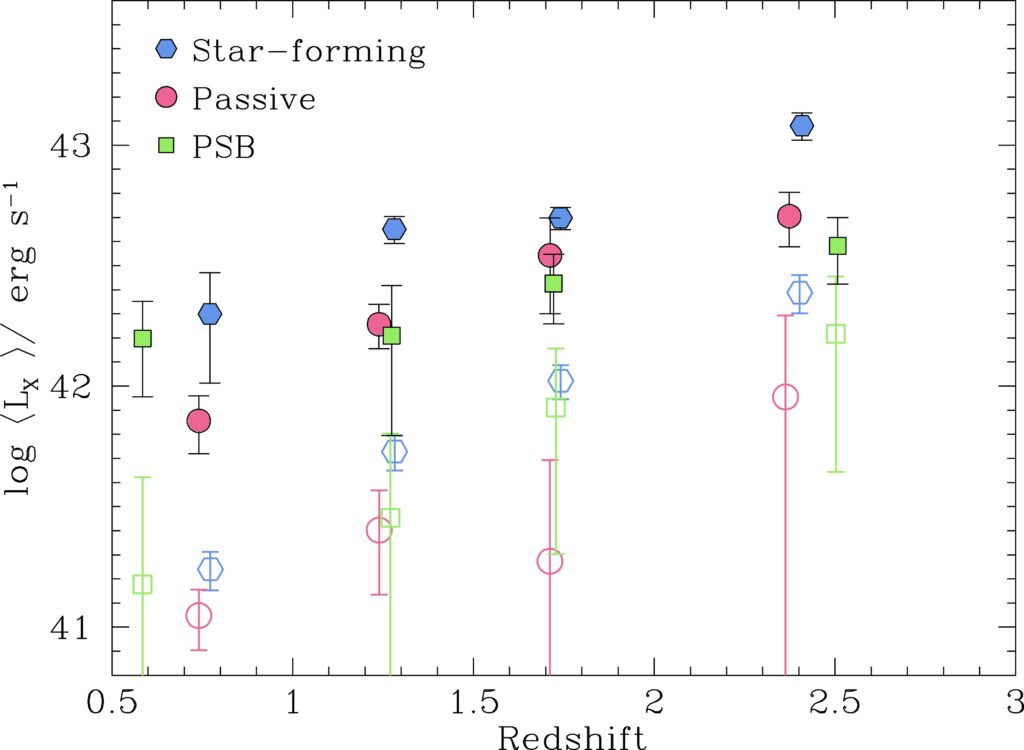
First, the authors examine the average X-ray luminosity of each sample (star-forming, passive, and post-starburst). They find that the star-forming sample has the highest X-ray luminosity, and therefore the most AGN. This makes sense, since the gas that can collapse to form new stars can also fall onto the galaxy’s supermassive black hole, fueling an AGN. Passive and post-starburst galaxies have similar X-ray luminosities (Figure 1). To examine this further, they look at the X-ray luminosity as a function of current star formation rate and find that there is a strong correlation between AGN activity and ongoing star formation.
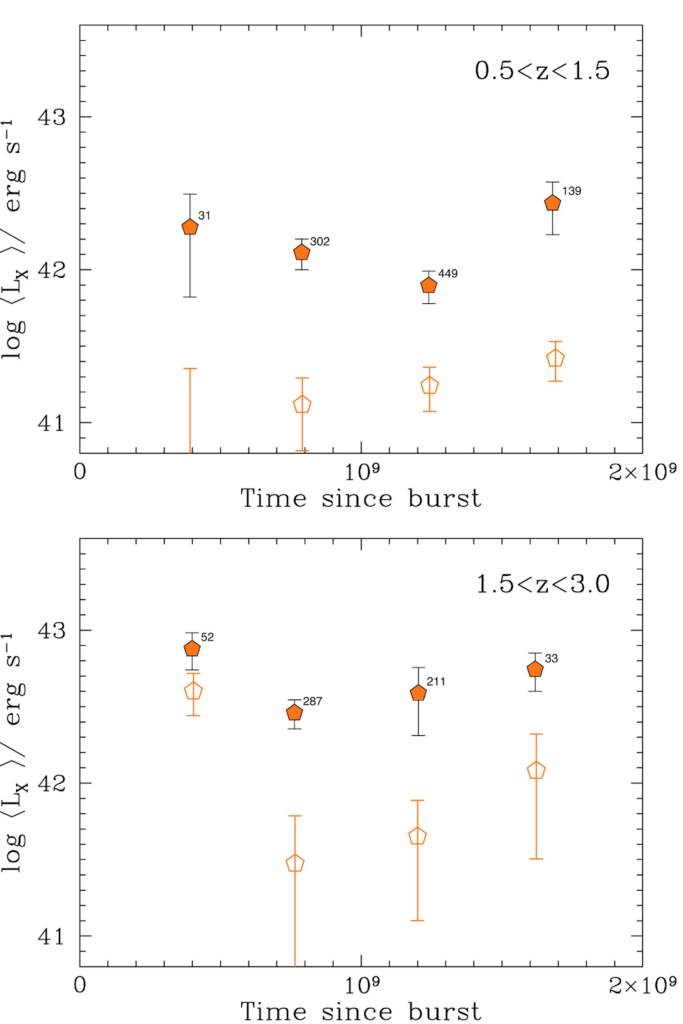
Simulations and some previous observational studies suggest that AGN should be most luminous a few hundred million years after a burst of star formation, then die down as the galaxy’s gas reservoir runs out. To test this idea, the authors next study the X-ray luminosity as a function of age since galaxy quenching for the passive and post-starburst galaxies. They find little evidence of a change in X-ray luminosity with galaxy age, where they would predict a spike in X-ray luminosity a couple hundred million years after star formation shut down (Figure 2). While they do observe a slightly higher X-ray luminosity in the most recently quenched galaxies, they argue that these galaxies have some residual star formation going on, and the slightly higher X-ray luminosity can be explained by the higher star formation rate in this time bin.
Is AGN feedback a myth?
So if post-starburst galaxies don’t have an elevated rate of AGN activity, does that mean that AGN feedback isn’t playing a (significant) role in galaxy quenching?
Well, that depends on the study. The authors discuss that previous studies have reached mixed results conclusions about whether post-starbursts have a high AGN fraction relative to other kinds of galaxies at different points in the Universe’s evolution. Post-starburst galaxies also have evidence of high rates of outflowing gas, which is thought to be driven by AGN and to aid in quenching.
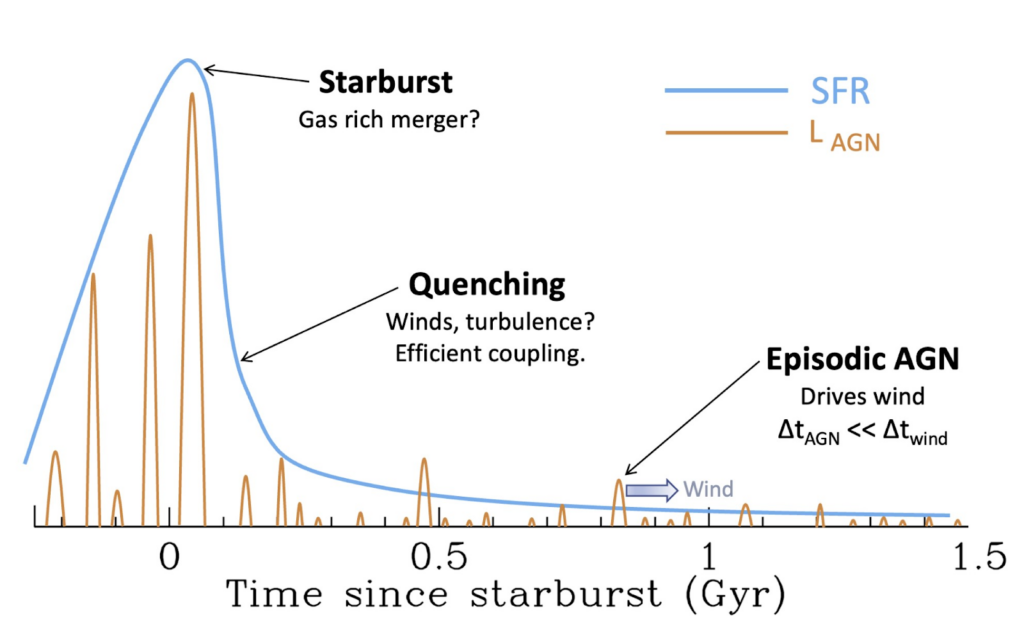
The authors suggest that the issue may be that AGN turn on and off very quickly relative to galaxy quenching. If AGN are “on” roughly 5% of the time, as evidenced by roughly 6% of post-starbursts with detected X-ray emission, their AGN may be enough to drive outflows—and therefore quenching—without a measured overabundance of currently-active AGN. They sketch their evolutionary track in Figure 3, which shows how the rapid flickering of the AGN leads to higher X-ray luminosities in more star-forming galaxies without completely suppressing AGN activity in post-starburst galaxies. The highly-active AGN can drive outflows during the starburst, but even lower levels of AGN activity may be enough to keep the gas out of galaxies after the starburst, maintaining the low rates of star formation in passive galaxies for billions of years.
So is AGN feedback a myth? Future studies with large samples of post-starburst galaxies and galaxy-AGN decomposition techniques will help us find out!
Astrobite edited by: Niloofar Sharei
Featured image credit: By ALMA (ESO/NAOJ/NRAO)/NASA/ESA/F. Combes
