
Title: Water Evolution and Inventories of Super-Earths Orbiting Late M Dwarfs
Authors: Keavin Moore, Benjamin David, Albert Yian Zhang, and Nicolas B. Cowan
First Author’s Institution: Department of Earth & Planetary Sciences, McGill University, Montréal, Canada
Status: Published in The Astrophysical Journal [open access]
We use bottles, and sometimes a Brita, but how do planets store their water? The authors of today’s paper made a model to find out, and to evaluate whether certain planets are good at hanging on to their water or not.
Water can be stored in planets within a few different reservoirs. Some of these may be familiar to you, such as in oceans or in the atmosphere as steam. Some however, might surprise you, such as inside a planet’s rocky mantle or even inside magma! Did you know that Earth’s mantle may be storing up to 12 times more water than all Earth’s oceans combined? That’s roughly 16 quintillion tons of water locked beneath the Earth’s crust – and magma is even better at storing water than rock!
Modelling Water Loss
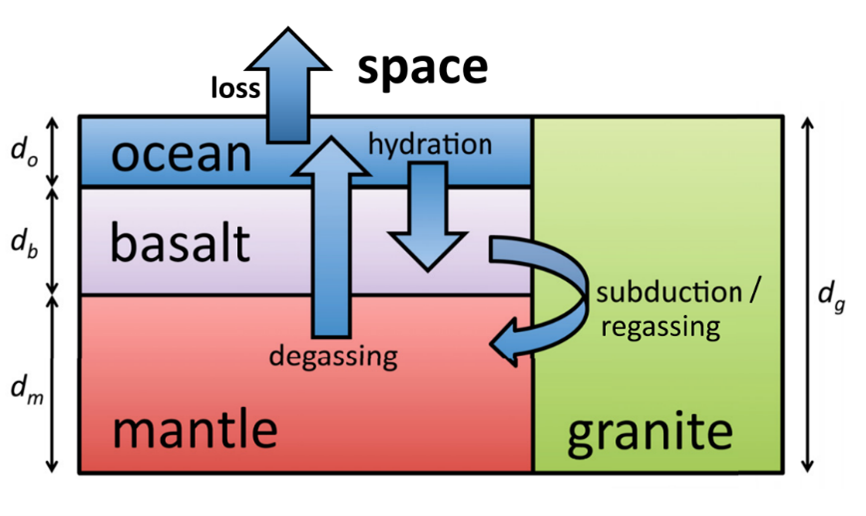
The authors focus on rocky planets of Earth’s mass and larger (a type of planet called super-Earths) that orbit small, dim M-dwarf stars. They are interested in these kinds of planets and stars because they are thought to be among the most common in the universe, and perhaps the most likely to host life! They create a “box model” that simulates how the planet passes water back and forth between different reservoirs over billions of years. For example, water can be released from the mantle onto the surface in a process called degassing, or can be returned from the surface back into the mantle in a process called regassing. The model also accounts for water loss to space by two different mechanisms; the first is energy-limited escape which is driven by the host star’s radiation (imagine a puddle drying up on a sunny day), and the second is diffusion-limited escape where light molecules are able to float up and away (you may have heard that the Earth is losing its helium because of this process).
To determine how much water remains on the surface for planets about the age of the Earth, the model is used to simulate five billion years of elapsed time. At the end of the simulations, if a planet’s surface has a lot of water on it, it’s called a waterworld, and it’s basically all ocean with no land. If the surface has a moderate amount of water, it’s deemed Earth-like, where it has both oceans and land. If it has a small amount of water on the surface, the planet is called a duneworld where there is some water in the atmosphere but no oceans. And finally, if it has no water on the surface at all, then it’s labeled completely desiccated. They test planets at different distances from the host star: at the inner edge of the habitable zone, the outer edge, and in the middle.
Temperamental Super-Earths
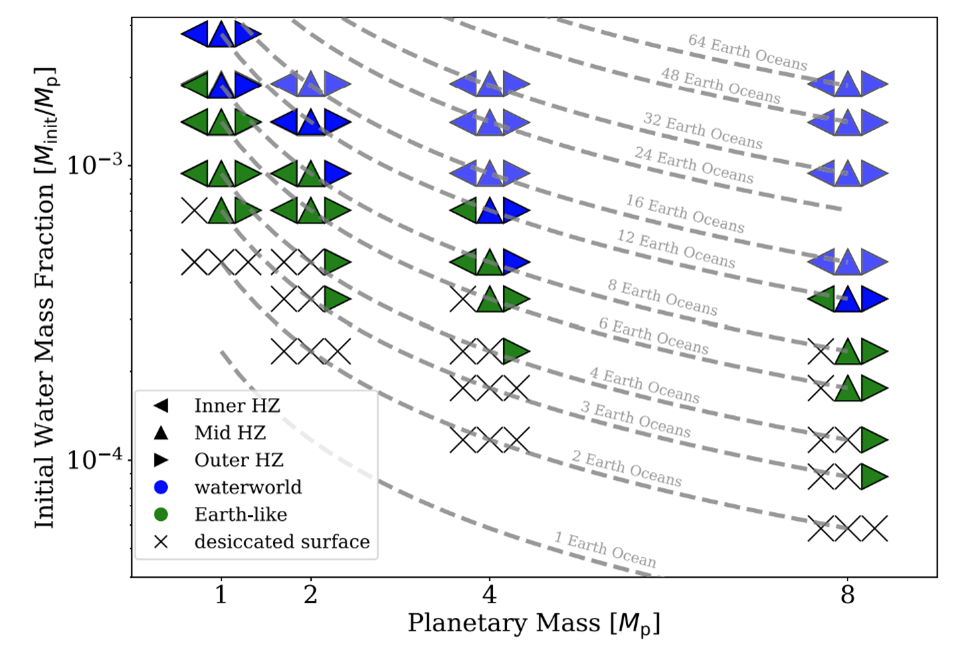
The authors find that a planet’s ability to store water in its mantle plays a large role in slowing water loss to space and allows it to degas water back to its surface over time. Overall, more massive super-Earths are less likely to have Earth-like surface conditions due to high amounts of water loss. Some of that water loss is to space, but some of the water is regassed into the mantle and never released, resulting in dry surface conditions. If the more massive planets begin with more initial water, as some planet formation theories suggest, then this water loss can be overcome, resulting in massive waterworlds. However, super-Earths with Earth-like surface conditions remain rare, only existing for a narrow range of initial water amounts. Less massive planets closer to Earth’s mass are more likely to have an Earth-like surface for a given set of starting conditions. The authors note that super-Earths may still be highly habitable, depending on whether waterworlds are conducive to life or not. This study finds that duneworlds are by and large very rare in the universe, which I’m glad to hear. No beaches? Come on!
So, whether you’re a planet or a person, if you’re spending time in the sun this week, make sure to keep some water on you and stay hydrated!
Astrobite edited by Flavia Pascal and Kaz Gary
Featured image credit: Composite of four worlds (top-left: “Oceanworld” by Pablo Carlos Budassi; top-right: “The Blue Marble” by NASA/Apollo 17 crew; bottom-left: “Image of Arrakis (Dune) like desert planet” by Merikanto; bottom-right: “Barrenplanet” by Pablo Carlos Budassi), via Wikimedia Commons, licensed CC BY-SA 4.0.

Incredibly interesting!! Learnt a lot from this.